

- June 2, 2026
- by Anoop Jain
The AI Skills That Mattered in 2025 Are Already Obsolete. Here’s What 2026 Demands
A year ago, the canonical AI engineer resume looked like this: LangChain experience, a Pinecone integration project, a ChatGPT API wrapper, something involving Hugging Face, and maybe a fine-tuning experiment that never left a notebook. That profile got you hired in 2025. It got you interviews. It got you salary offers that felt like the market was broken in your favor.
That same resume in 2026? It’s table stakes at best. A red flag at worst.
The shift happened faster than anyone predicted. In twelve months, the AI engineering discipline didn’t evolve incrementally — it underwent a phase transition. The skills that defined “AI-ready” in 2025 are now the baseline that hiring managers assume you have before the real conversation starts. And the skills that actually differentiate in 2026 — the ones companies are paying $185K to $320K for — didn’t exist as recognized job requirements eighteen months ago.
This isn’t normal technology drift. The World Economic Forum estimates that 39% of current technical skills will be obsolete or transformed by 2030. In AI, that timeline compressed to roughly one year. The skills gap isn’t coming. It arrived. And the companies that haven’t updated their talent model are building with yesterday’s playbook in a market that rewards only today’s.
What “AI Skills” Meant in 2025
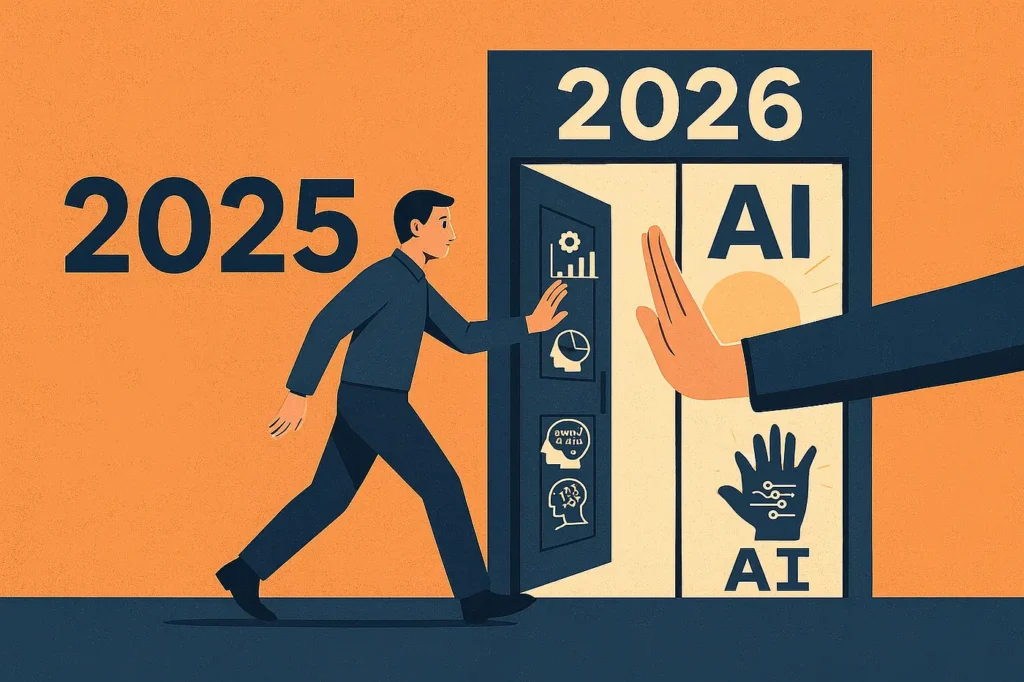
Let’s be specific about what the 2025 AI skill landscape looked like — because understanding what expired is essential to understanding what replaced it.
Basic LLM integration. The dominant skill in 2025 was “can you call the OpenAI API and do something useful with the response?” This meant wrapping GPT-4 in a product feature, building simple chatbots, and creating text generation pipelines. The tooling was LangChain, the integration was API-call-and-display, and the deployment was “it works on my laptop.”
Simple RAG pipelines. Retrieval-augmented generation was the hot architecture of 2025. Take a corpus of documents, chunk them, embed them in a vector database like Pinecone, and retrieve relevant context before prompting the LLM. The pattern was powerful and genuinely useful. But the 2025 version was crude — search once, summarize, return. No iterative retrieval. No source validation. No evaluation of whether the retrieved context was actually sufficient.
Prompt engineering as a standalone skill. In 2025, “prompt engineer” was a viable job title by itself. Writing effective prompts, crafting system messages, and designing few-shot examples was enough to command a role and a salary. The discipline was valuable, but it was treated as an end in itself rather than a component of a larger system.
Fine-tuning as a research exercise. Teams experimented with fine-tuning foundation models on domain-specific data. Most of the work lived in notebooks. The evaluation was vibes-based — “does this output feel right?” The deployment path was unclear. The production implications were unaddressed.
MLOps for traditional ML. The MLOps practices of 2025 were designed for classical machine learning — model registries, training pipelines, and performance monitoring for deterministic models. These practices were mature and valuable, but they weren’t designed for the non-deterministic, multi-step, autonomous systems that 2026 demands.
None of these skills are worthless. They’re foundational. But treating them as sufficient in 2026 is like listing “can use Microsoft Word” on a resume in 2010. It’s assumed. It’s not what gets you hired.
What Changed — And Why It Changed So Fast
Three converging forces drove the skill landscape from “2025 sufficient” to “2026 obsolete” in under twelve months.
Force 1: Agentic AI went from concept to production. In 2025, agentic AI was a conference topic. By early 2026, roughly 60% of new enterprise software projects include an agentic component. AI agents — systems that plan, reason, use tools, and execute multi-step workflows autonomously — became the default architecture for serious AI deployment. This didn’t just add new skills to the list. It redefined what “AI engineering” means at a fundamental level.
Force 2: MCP became foundational infrastructure. The Model Context Protocol crossed 97 million monthly installs by March 2026. Every major AI provider adopted it. It became the universal standard for connecting AI agents to enterprise systems. Overnight, “AI integration” stopped meaning “call an API” and started meaning “design a semantically rich server that AI agents can discover, evaluate, and use autonomously.” A skill set that literally didn’t exist in 2024 became mandatory in 2026.
Force 3: The model layer commoditized. With GPT-5.4, Claude Opus 4.6, Gemini 3.1, and powerful open-source models all shipping within weeks of each other, the ability to “use an LLM” stopped being a differentiator. When everyone has access to the same frontier models, the value shifts from “can you call the model” to “can you build the system around it” — the orchestration, the evaluation, the deployment, the governance, the cost optimization.
The cumulative effect: the entire gravity of AI engineering shifted from “model interaction” to “system architecture.” The 2025 skill set was about talking to models. The 2026 skill set is about building autonomous systems that talk to each other, talk to tools, and operate in production without constant human supervision.
The 10 Skills That Actually Matter in 2026
Here’s what production AI teams are actually hiring for right now — drawn from real job postings, real salary data, and real deployment requirements. These aren’t predictions. They’re the current state.
- Agent Orchestration
The single most differentiated skill in 2026. Designing multi-agent systems where specialized agents collaborate, delegate, and self-correct. Understanding planning loops, sub-agent coordination, failure mode handling, and when to escalate to a human. Frameworks: OpenAI Agents SDK, CrewAI, LangGraph, AutoGen. This is the skill that separates mid-level from senior, and it commands the highest salary premiums.
- MCP Integration
Building MCP servers that connect AI agents to enterprise systems — databases, CRMs, APIs, internal tools. This means designing semantic interfaces that agents can discover and use intelligently, implementing progressive discovery patterns, handling OAuth 2.1 authentication, and building governance layers. If you’re building agents in 2026 and you’re not using MCP, you’re building on legacy infrastructure.
- Evaluation Design
The skill that every production team needs and almost nobody has. Building evaluation harnesses that objectively measure whether an AI system — especially an agentic one — is actually working. Not “does the output feel right?” but structured benchmarks, regression test suites, hallucination detection, and automated quality scoring. This is the universal screen in 2026 interviews.
- Agentic RAG
RAG didn’t die — it evolved. The 2025 version was search-once-and-summarize. The 2026 version is iterative: the agent searches, evaluates whether the information is sufficient, searches again if needed, validates sources, and combines findings. This requires deep understanding of vector databases, embedding models, chunking strategies, retrieval evaluation, and the ability to design agents that know when they don’t know enough.
- Production Observability
Monitoring autonomous AI systems in production is fundamentally different from monitoring traditional software. You need real-time tracking of agent decision chains, tool-call success rates, latency at every step, cost-per-interaction, and drift detection for non-deterministic outputs. The tooling is still emerging, which means the engineers who can build custom observability are extraordinarily valuable.
- Cost Optimization
With agentic systems making dozens of LLM calls per workflow, cost management became an engineering discipline. Model routing — deciding which queries go to expensive frontier models versus cheaper alternatives. Caching strategies. Token budget management. The ability to reduce inference costs by 40-60% without degrading quality separates production-ready engineers from prototype builders.
- Safety and Guardrails
Designing the boundaries that keep autonomous systems from going off the rails. Input validation, output filtering, action sandboxing, human-in-the-loop escalation triggers, and adversarial robustness testing. The OWASP LLM Application Top 10 has cataloged the threat landscape, and the OpenSSF has identified over 80 attack techniques targeting tool-based LLM systems. Every agent-facing role needs this skill.
- Prompt Architecture (Not Just Prompt Engineering)
Prompt engineering as a standalone skill has been absorbed into the broader discipline. What matters now is prompt architecture — designing system prompts for multi-agent systems, building chain-of-thought frameworks that work across agent handoffs, creating few-shot strategies that scale, and building evaluation harnesses that measure prompt effectiveness objectively. The difference is between writing a prompt and designing a prompt system.
- Computer Use Deployment
GPT-5.4 scored 75% on OSWorld — surpassing the human expert baseline for operating desktop environments. Building AI systems that can navigate applications, interact with web interfaces, and execute complex digital workflows is no longer experimental. The engineers who can deploy computer-use capabilities in enterprise environments — with proper security, governance, and reliability — are among the rarest and most sought-after in the market.
- Frontier Model Fluency
With multiple frontier models releasing every month, engineers need to track capabilities across providers, understand the tradeoffs between models for specific use cases, and architect systems that aren’t locked to a single provider. This isn’t about “knowing GPT” — it’s about understanding the comparative strengths of GPT-5.4 versus Claude Opus 4.6 versus Gemini 3.1 versus open-source alternatives, and making informed architectural decisions based on cost, latency, capability, and compliance requirements.
The Roles That Didn’t Exist — And Now Command $200K+

The skill shift created entirely new job categories. Eight distinct agentic AI roles have crystallized in 2026, and they’re commanding salaries that reflect their scarcity.
Agentic AI Engineer ($185K–$320K) — Builds the actual agent loops: tool calling, sub-agent orchestration, memory, evaluation harnesses. This is the role every enterprise is fighting over.
AI Agent Architect ($200K–$350K) — Designs the system-level architecture for multi-agent deployments. How agents interact, how they’re governed, how they scale. More strategic than the engineer role, fewer in number.
MCP Integration Engineer ($170K–$280K) — Builds and maintains the connectivity layer between agents and enterprise systems. The plumbing that makes agentic AI actually work.
AI Evaluation Specialist ($160K–$260K) — Designs testing and quality frameworks for non-deterministic AI systems. The person who answers “is this agent actually working?”
AI Safety Engineer ($175K–$290K) — Builds guardrails, sandboxing, adversarial testing, and compliance controls for autonomous systems. Increasingly mandatory as the EU AI Act approaches.
AI Orchestration Lead ($190K–$310K) — Manages the operational complexity of multi-agent systems in production. Observability, cost optimization, and incident response.
AI Trainer / RLHF Specialist ($140K–$220K) — Designs and manages the human feedback loops that improve agent behavior over time.
AI Agent Product Manager ($170K–$280K) — Translates business objectives into agent specifications. Defines what agents should do, how they should be evaluated, and what success looks like.
These roles didn’t appear on any salary survey in 2024. By 2026, they represent the highest-demand, highest-compensation segment of the AI job market.
Why Your Current Team Probably Has the Wrong Skills
This isn’t a criticism of your engineers. It’s a structural observation.
The people you hired in 2024 and early 2025 were hired for the skills that mattered then — LLM integration, basic RAG, traditional MLOps, prototype-level experimentation. They were the right hires at the time. But the landscape shifted underneath them, and the gap between “what they know” and “what 2026 demands” grew faster than any upskilling program could close.
Consider the math. Your senior AI engineer was hired eighteen months ago for their LangChain expertise and fine-tuning experience. Those skills are now baseline. The skills they need — agent orchestration, MCP integration, evaluation design, production observability, cost optimization — require months of hands-on experience building production systems. Not courses. Not certifications. Hands-on deployment experience.
Upskilling is essential for the long term. But it doesn’t solve the immediate problem: you have initiatives on your 2026 roadmap that require skills your team doesn’t have yet, and the hiring market for those skills is so competitive that traditional recruitment takes four to six months for roles that have been in existence for less than twelve.
This is exactly the gap AI staff augmentation was designed to fill.
How gNxt Systems Bridges the Skills Gap
At gNxt Systems, we don’t just track the skills shift — we staff for it in real time.
Our specialist network is built specifically for the 2026 landscape. Every engineer has documented production experience in the skills that actually matter right now — agent orchestration, MCP integration, evaluation design, production observability, agentic RAG, cost optimization, guardrail engineering, and frontier-model architecture. These aren’t generalists who read the docs last week. They’re practitioners who’ve built and deployed the systems your roadmap describes.
We staff across all ten critical skill areas and all eight emerging agentic roles. Whether you need a single specialist to unblock a specific workstream or a full augmented squad to deliver an agentic initiative end-to-end, we place pre-vetted engineers on your team within one to two weeks.
And every engagement is designed to close the skills gap permanently — not just temporarily. Our specialists pair-program with your internal engineers, document architecture decisions, run structured knowledge transfer sessions, and conduct formal handoffs. When they roll off, your team doesn’t just have a working system. They have the 2026 skills they didn’t have before.
The skills expired. The roadmap didn’t. We bridge the gap between the two.
References & Sources
- Digital Applied — “AI Developer Hiring 2026: Skills That Actually Matter” (May 2026) —
https://www.digitalapplied.com/blog/ai-developer-hiring-skills-that-matter-2026 - The AI Career Lab — “The Agentic-AI Job Guide: 8 New Roles, What They Pay, and How to Break In” (April 2026) — https://theaicareerlab.com/blog/agentic-ai-jobs-guide-2026
- First Line Software — “AI Software Development: What Changes from 2026 to 2035” (May 2026) — https://firstlinesoftware.com/blog/ai-software-development-2026-2035/
- ODSC — “The Core Skills AI Practitioners Need for Agentic AI in 2026” (January 2026) — https://odsc.medium.com/the-core-skills-ai-practitioners-need-for-agentic-ai-in-2026
- AI Staffing Ninja — “Agentic AI Engineers: Most In-Demand Hire for 2026” (March 2026) — https://www.aistaffingninja.com/blog/beyond-llms-agentic-ai-engineers/
Frequently Asked Questions (FAQs)
Q1. What AI skills from 2025 are now considered obsolete or insufficient in 2026?
Q2. What are the most in-demand AI skills for 2026?
Q3. What new AI job roles have emerged in 2026 that didn't exist before?
Q4. Can existing AI teams be retrained for 2026 skills, or do companies need to hire new people?
Q5. How does AI staff augmentation help companies keep pace with rapidly changing AI skills?
About Author

CEO at gNxt Systems
with 25+ years of expertise, Mr. Anoop Jain delivers complex projects, driving innovation through IT strategies and inspiring teams to achieve milestones in a competitive, technology-driven landscape.
Table of ContentsToggle Table of ContentToggle