- September 1, 2026
- by Anoop Jain
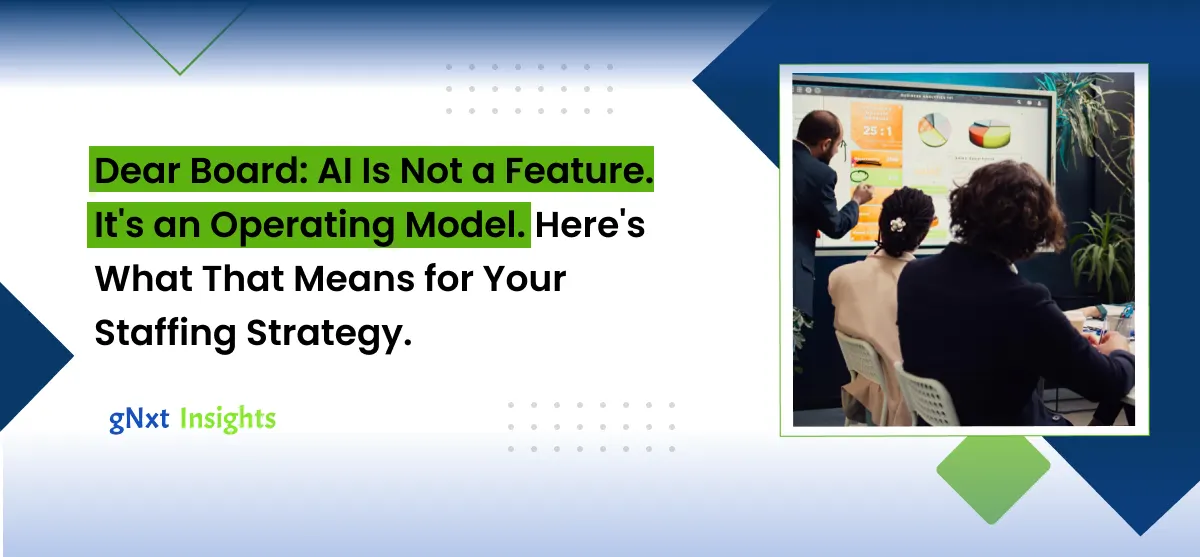
Dear Board: AI Is Not a Feature. It’s an Operating Model. Here’s What That Means for Your Staffing Strategy
Every board deck has one. Somewhere between the quarterly revenue update and the competitive landscape slide, there’s a line that reads: “AI Roadmap — On Track.” Beneath it, a handful of bullet points. A chatbot here. A predictive model there. An “AI-powered” label affixed to a feature that shipped last quarter.
The board nods. The line item gets approved for another quarter of funding. Everyone moves on to the next slide.
Here’s the uncomfortable truth this deck is hiding: treating AI as a feature — a checkbox on a product roadmap, a line item to fund and monitor — is precisely why 97% of executives believe AI will transform their companies while only 4% are generating substantial value from it. That 93-point gap between belief and delivery isn’t a technology problem. It’s a category error at the board level, and it’s costing companies more than the failed pilots ever will.
AI is not a feature you ship and move past. It’s an operating model — a fundamental restructuring of how work gets planned, executed, governed, and staffed. And boards that keep evaluating AI investment through the feature lens are approving budgets that were never going to produce transformation, because features get built by project teams and operating models get built by workforces designed for a different way of working entirely.
This distinction isn’t academic. It determines whether your next AI dollar produces a shipped capability or another line item that says “on track” for four more quarters.
Why the Feature Mental Model Fails at the Board Level
When a board treats AI as a feature, it inherits every assumption that comes with feature-based thinking — and every one of those assumptions is wrong for AI.
Features are scoped and finite. AI capability is continuous and compounding. A feature ships, and the team moves to the next feature. AI doesn’t work that way. The agentic system you deploy this quarter needs continuous evaluation, monitoring, retraining, and governance for as long as it operates — which is indefinitely. Funding AI like a feature (one-time budget, defined delivery date, project team disbands after launch) guarantees the capability degrades the moment the project team moves on.
Features are owned by a product team. Operating models touch every function. A feature lives in a product roadmap and is delivered by engineering. An operating model reshapes how legal reviews contracts, how support resolves tickets, how finance forecasts, and how HR staffs teams — simultaneously. Deloitte’s 2026 research is explicit on this point: the technology function itself must be re-architected as AI agents and humans work together across strategy, architecture, product management, and value realization. That’s not a product initiative. That’s organizational redesign.
Features need developers. Operating models need a workforce architecture. This is the gap board members feel but rarely name directly. You can hire developers to build a feature. You cannot hire your way to an operating model with the same playbook, because an operating model requires a mix of permanent strategic ownership, rotating specialized execution, and continuous governance — a workforce shape that doesn’t exist in a traditional headcount plan.
The board that keeps asking “when will the AI feature ship?” is asking the wrong question. The right question is: “What workforce architecture does this operating model require, and do we have it?”
The 10-20-70 Rule Every Board Needs to Internalize
There’s a framework circulating among enterprise AI strategists in 2026 that boards should adopt as a standing agenda item: the 10-20-70 rule. Only 10% of AI success depends on algorithms. Only 20% depends on infrastructure. The remaining 70% depends on people and process.
Read that allocation again against your current AI budget. If your board is approving spend that’s 70% infrastructure and model licensing and 10% workforce strategy, you’ve inverted the actual value driver. You’re funding the 30% that matters least and starving the 70% that determines whether any of it works.
This isn’t a minor calibration error. It’s why so many AI initiatives reach what practitioners now call “pilot purgatory” — permanently stuck in proof-of-concept, technically impressive, organizationally unable to scale. Deloitte’s 2026 Global Technology Leadership research found that while 58% of technology executives say they’re prepared to modernize platforms and build AI capabilities, the honest barrier isn’t platform readiness. Insufficient worker skills remains the single biggest obstacle to integrating AI into existing workflows.
The board’s job isn’t to approve the biggest AI budget. It’s to ensure the budget is allocated against the actual driver of success — and right now, across the industry, boards are systematically under-investing in the 70% that matters.
What “Operating Model” Actually Means for Your Workforce

If AI is genuinely an operating model rather than a feature, then the workforce implications cascade through the entire organization — not just engineering. Here’s what that restructuring actually requires.
A permanent strategic core that owns outcomes, not just outputs. Every AI operating model needs a small group of people — not a large department, a genuinely small core — who hold institutional knowledge, own the roadmap, and are accountable for business outcomes rather than technical deliverables. This is fundamentally different from a traditional engineering headcount plan. These people need to understand the business as deeply as the technology, because the emerging pattern across enterprises is roles like AI operations managers, human-AI interaction specialists, and quality stewards — positions that didn’t exist eighteen months ago and signal that AI has become a structural component of how work is organized, not an add-on to it.
A rotating specialized layer that executes against evolving requirements. The specific technical execution — building agentic workflows, integrating MCP-connected systems, deploying evaluation frameworks — requires skills that are simultaneously highly specialized and rapidly evolving. This is precisely the category of work that a permanent headcount model handles badly. You don’t need a full-time agentic AI architect on payroll for the next five years. You need that expertise for the specific 90-day window when you’re building the capability, and you need it to be replaceable with different specialized expertise when the next capability comes online.
A governance function that scales with autonomy, not with headcount. As AI systems move from isolated experiences toward coordinated systems of action — the direction the entire enterprise AI market is moving in 2026 — the governance burden doesn’t scale linearly with the number of AI features you deploy. It scales with the level of autonomy those systems exercise. A chatbot that answers questions needs light governance. An agentic system that approves transactions, modifies records, or takes autonomous action across departments needs governance infrastructure that most organizations have never had to build.
Cross-functional workforce redesign, not just technical hiring. Only 36% of organizations report they’re assessing target talent acquisition levels and hiring specialized talent to drive AI initiatives — even though 53% are focused on raising general AI fluency and 48% are designing upskilling strategies. That gap is telling. Boards are approving broad education initiatives while under-investing in the specific specialized hiring that determines whether the operating model actually functions. Teaching your existing workforce to use AI tools is necessary. It is not sufficient to build an operating model that requires agentic architecture, MCP integration, and production-grade AI governance.
The Staffing Model Question Every Board Should Be Asking

Here is the question board members should put directly to their executive teams — not “how is the AI roadmap tracking,” but a sharper, more consequential version:
“Is our AI workforce structured as a project team or an operating capability?”
A project team is assembled to build something, then disbanded or reassigned once it ships. This is exactly backward for AI, because the moment a system ships is the moment it needs sustained monitoring, governance, and iteration — the moment its operating requirements begin, not end.
An operating capability is structured differently. It has a permanent core that persists across initiatives. It has a flexible layer of specialized expertise that scales up and down based on what the current initiative demands. It has governance built in from the start, not bolted on after an incident. And critically, it has a staffing model that can access the right specialized skill within weeks — not the four-to-six-month cycle that traditional hiring requires, and that no operating model, by definition, can tolerate as its default execution speed.
This is the strategic distinction that separates the 4% of companies generating substantial AI value from the 97% who believe in AI’s transformative potential but can’t deliver it. The 4% didn’t get there with a bigger feature budget. They got there by building a workforce architecture that matches the continuous, cross-functional, rapidly evolving nature of what AI actually requires operationally.
What This Means for Your Next Budget Cycle
If your board accepts that AI is an operating model rather than a feature, three concrete shifts follow — and they should show up in your next budget conversation, not your next strategy offsite.
Shift the 70% allocation, not just the language. Stop approving budgets where workforce and process investment is an afterthought to infrastructure and licensing spend. The 10-20-70 rule isn’t a slogan. It’s a resource allocation discipline that should be visible in the actual numbers your CFO presents.
Separate “build” headcount from “operate” headcount — and staff each differently. The people who architect and build a new agentic capability need deep, current, specialized technical expertise — often expertise that doesn’t exist in-house and shouldn’t be hired permanently for a single initiative. The people who own the operating model long-term need business context and institutional continuity more than they need to be at the technical frontier. Conflating these two staffing needs into one generic “AI headcount” line item guarantees you’ll be understaffed on both.
Demand a staffing model, not just a hiring plan, in every AI initiative proposal. Before approving budget for the next AI capability, ask the executive sponsoring it: what’s the mix of permanent core, specialized augmentation, and governance infrastructure this requires? If the answer is “we’ll hire a team,” push back. That’s project-team thinking applied to an operating-model problem, and it’s the single most common reason approved AI budgets produce pilots instead of transformation.
How gNxt Systems Helps Boards Move From Feature Funding to Operating Model Investment
This is the exact strategic gap gNxt Systems exists to close — not just for engineering teams, but for the board-level resource allocation decisions that determine whether AI investment produces an operating capability or another stalled pilot.
We work with organizations at every point in this transition. For companies still funding AI as isolated features, we help design the workforce architecture that turns those features into a sustained operating capability — the permanent core, the specialized augmented layer, and the governance function that scales with autonomy.
For companies ready to build agentic capability, we offer three paths matched to where you are: our in-house team delivers turnkey agentic AI systems when you need the capability built, our AI staff augmentation embeds specialized expertise into your existing team when you have the core but need the specialized execution layer, and our AI Team Development model builds your permanent operating capability from the ground up when you’re ready to own this long-term.
In every model, the underlying principle is the same one boards need to internalize: AI success is 70% people and process, and the workforce architecture that supports an operating model looks nothing like the project team that ships a feature. Getting that architecture right is not an engineering decision. It’s a board-level resource allocation decision — and it’s the one most boards are still getting wrong.
The Slide Your Board Actually Needs
Replace the “AI Roadmap — On Track” slide with a different question: “What operating model are we building, and is our workforce architecture designed for it?”
If the honest answer involves a project team that will disband after the current initiative ships, you don’t have an AI operating model. You have a very expensive feature — one that will need to be rebuilt, restaffed, and re-funded the moment the market moves, because the team that built it moved on and nobody was structured to own what happens next.
The companies pulling ahead in 2026 aren’t the ones with the most AI features on their product pages. They’re the ones whose boards understood, early, that AI was never a line item to approve and forget. It’s an operating model that requires a workforce built to match — and that distinction, more than any algorithm or infrastructure investment, is what separates the 4% from the 97%.
References & Sources
- Deloitte — “Rewiring the Enterprise Operating Model for AI Scale” (June 2026) — https://www.deloitte.com/us/en/insights/topics/technology-management/rewiring-ai-operating-model.html
- Deloitte — “The State of AI in the Enterprise” (2026 Report) — https://www.deloitte.com/us/en/what-we-do/capabilities/applied-artificial-intelligence/content/state-of-ai-in-the-enterprise.html
- Iternal AI — “Enterprise AI Strategy Guide 2026: Framework for CIOs” (April 2026) — https://iternal.ai/ai-strategy-guide
- Inry — “What Knowledge 2026 Revealed About the Next Enterprise AI Operating Model” (May 2026) — https://www.inry.com/insights/what-knowledge-2026-revealed-about-the-next-enterprise-ai-operating-model
- Forbes Technology Council — “How AI Will Rewrite Enterprise Strategy in the Coming Years” (August 2026) — https://www.forbes.com/councils/forbestechcouncil/2026/08/26/how-ai-will-rewrite-enterprise-strategy-in-the-coming-years/
Q1. Why do most enterprise AI initiatives fail to move beyond the pilot stage?
Q2. What's the difference between treating AI as a "feature" versus an "operating model" at the board level?
Q3. What workforce structure does an AI operating model actually require?
Q4. Why are only 36% of organizations focused on hiring specialized AI talent, according to industry surveys?
Q5. How can boards ensure AI budget produces an operating capability instead of another stalled pilot?
About Author

CEO at gNxt Systems
with 25+ years of expertise, Mr. Anoop Jain delivers complex projects, driving innovation through IT strategies and inspiring teams to achieve milestones in a competitive, technology-driven landscape.
Table of ContentsToggle Table of ContentToggle