- July 12, 2026
- by Anoop Jain
Claude Can Now Spawn Sub-Agents That Spawn Sub-Agents. Are We Watching the Death of the Single AI Assistant?
A few weeks ago, Anthropic quietly pushed an update to Claude Code — version 2.1.172 — that most people scrolled past. No new model. No flashy launch event. Just a capability change that, if you understand what it means, rewrites the rules of how AI work gets done.
Sub-agents can now spawn their own sub-agents.
Read that again. Not “Claude can delegate tasks to helper agents.” That’s been possible since 2025. What’s new is recursive delegation — a lead agent breaks a job into pieces, hands each piece to a sub-agent, and those sub-agents can break their own work into further pieces and delegate again. The reviewer sub-agent that checks your code diff? It can now dispatch a separate verifier for each finding, and only the top-level summary returns to your main conversation. All the back-and-forth — the twelve-message argument between reviewer and verifiers — stays buried two levels down.
Then, in June 2026, Anthropic went further with Dynamic Workflows: the lead agent can now plan and fan out tens to hundreds of parallel sub-agents in a single session, each with its own context window, its own tools, and its own model. A separate grading layer called Performance Outcomes sends each sub-agent back to revise until its output meets a defined rubric. Anthropic reported up to a ten-point lift on their hardest internal benchmarks.
And underpinning it all: the Claude Agent SDK, now available in both Python and TypeScript, exposes the same infrastructure that powers Claude Code — file editing, bash execution, web search, tool-use loops, sub-agents, persistent sessions, and MCP support — as a library developers can point at any problem.
This isn’t an incremental upgrade. It’s the moment the single AI assistant — the chatbot, the one-shot Q&A system, the solitary helper in a sidebar — became architecturally obsolete.
From One Mind to Many: What Multi-Agent Claude Actually Looks Like
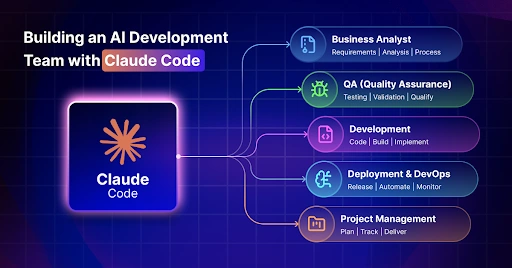
To understand why this matters, you need to see what’s actually happening under the hood when Claude delegates.
The old model — the one most people still interact with — is straightforward. You send Claude a prompt. Claude processes it in a single context window. Claude returns a response. One mind, one task, one answer. This is the architecture of every chatbot, every AI assistant, every “ask me anything” interface you’ve ever used.
The new model is fundamentally different.
When you hand Claude Code a complex task, it doesn’t try to hold the entire problem in one context window and grind through it start to finish. It analyzes the task, develops a strategy, and spawns specialized sub-agents — each operating in its own isolated context window with its own tools, permissions, and even its own model. These sub-agents work in parallel, executing their assigned pieces simultaneously on a shared file system. Their results feed back to the lead agent, which synthesizes everything into a coherent output.
Anthropic’s own multi-agent research system illustrates the pattern perfectly. When a user submits a research query, the lead agent analyzes it, develops a strategy, and spawns sub-agents to explore different aspects simultaneously. Each sub-agent iteratively uses search tools, evaluates what it finds, decides if it needs to search again, and returns its findings to the lead agent for synthesis. In Anthropic’s internal evaluations, this multi-agent system with Claude Opus 4 as the lead and Claude Sonnet 4 sub-agents outperformed single-agent Claude Opus 4 by 90.2% on research tasks.
Ninety percent better. Not by using a bigger model. By using the same models organized into a coordinated team.
This is the architectural shift that changes everything. The unit of AI work is no longer a single model call. It’s a coordinated team of agents — each specialized, each autonomous within its scope, each contributing to an outcome that no single agent could achieve alone.
The Two Delegation Patterns Enterprise Teams Need to Understand
Inside Claude Code, Anthropic has shipped two distinct delegation patterns. They look similar on the surface but are architecturally different, and understanding the distinction is critical for anyone building with this technology.
Sub-Agents: The Hierarchy. Sub-agents follow an orchestrator-worker pattern. One Claude instance sits at the top, breaks work into pieces, and delegates each piece to a child agent. The lead defines what each sub-agent does, what tools it can access, and what model it runs on. The sub-agents execute independently in their own context windows and return summaries to the lead. It’s a tree structure — command flows down, results flow up.
In practice, you create a sub-agent by dropping a markdown file into a project folder with a name, description, tools, model assignment, and system prompt. The lead reads the description to decide when to delegate — the same way it reads tool descriptions to decide when to call a tool. Three to five concurrent sub-agents is the sweet spot for most jobs. Beyond that, you spend more time merging summaries than you save by running in parallel. Dynamic Workflows pushes this ceiling to tens or hundreds for tasks that genuinely fan out — running a benchmark suite across eighty model-prompt combinations, for instance — but for everyday work, the three-to-five rule holds.
Agent Teams: The Flat Network. Agent Teams, launched in research preview in February 2026, use a fundamentally different topology. Instead of a hierarchy with one orchestrator routing tasks, Agent Teams are a flat group of Claude instances coordinating through shared state. There’s no single boss. Each agent has visibility into what the others are doing and can coordinate laterally. The mental model is closer to a squad of engineers working on a shared codebase than a manager delegating to direct reports.
The distinction matters because different work fits different patterns. Sub-agents are ideal when you can cleanly decompose a task into independent pieces — research different topics, review different files, test different configurations. Agent Teams are better when the pieces have dependencies and agents need to coordinate in real time — building a feature that touches multiple files, refactoring a system where changes cascade across modules.
Why This Kills the Single AI Assistant Model
The single AI assistant — the chatbot in a sidebar, the Q&A box, the one-shot prompt-and-response system — has been the dominant paradigm since GPT-3 launched. Every enterprise AI deployment of the past three years has been some variation of “ask the AI a question, get an answer.”
That model has a ceiling. And we’ve hit it.
A single agent has one context window. One thread of reasoning. One set of tools active at a time. When a task grows beyond what fits in that window — or when different parts of a task have no dependency on each other — a single agent is inefficient by design. It processes everything sequentially, even when parallel execution would be faster. It loses context as conversations grow long. It can’t specialize — the same generalist prompt handles research, analysis, writing, and verification.
Multi-agent architectures break through every one of these limitations. Multiple context windows mean more total reasoning capacity. Parallel execution means dramatically faster completion. Specialization means each agent can be optimized for its specific subtask — a research agent uses different tools and prompts than a code-writing agent, which uses different ones than a verification agent.
The numbers make the case. Agents typically use about four times more tokens than chat interactions. Multi-agent systems use about fifteen times more. But for tasks where the value justifies the cost — and in enterprise, the tasks that matter always justify the cost — multi-agent systems produce results that single agents simply cannot match. Anthropic’s 90.2% improvement on research benchmarks isn’t an anomaly. It’s the natural consequence of applying the same principle that makes human teams more capable than human individuals: division of labor, specialization, and coordination.
The single AI assistant isn’t going to disappear overnight. For simple questions, quick tasks, and casual interactions, a single agent is perfectly adequate — the way a sole proprietor is adequate for a one-person business. But for the complex, multi-step, high-stakes work that enterprises actually need AI to do — the agentic workflows, the production systems, the autonomous processes — the single assistant model is already dead. The multi-agent model is what replaced it.
What This Means for Enterprise AI Teams
This architectural shift has immediate, practical implications for every company building with AI.
Your AI features need to be designed for multi-agent from the start. If you’re still architecting AI systems as single-model, single-prompt pipelines, you’re building for a paradigm that’s already being surpassed. The features on your 2026 roadmap — intelligent automation, agentic workflows, autonomous document processing — will deliver dramatically better results when designed as multi-agent systems with specialized sub-agents for each component of the task.
The skill requirements just changed. Again. Building multi-agent systems requires skills that most AI teams don’t have: orchestrator design, sub-agent scoping, parallel coordination patterns, shared-state management, token budget optimization across agent hierarchies, and the governance frameworks that keep autonomous multi-agent systems safe and auditable. These are the skills that separate teams shipping production agentic AI from teams still building chatbots.
Cost management becomes an engineering discipline. Multi-agent systems burn through tokens fast. Each sub-agent consumes its own context window. A fan-out of many verbose reports creates compounding costs. The ability to route routine research to smaller, cheaper models while keeping consequential decisions on frontier models — the ability to manage token budgets across agent hierarchies — becomes a core engineering skill, not a finance afterthought.
Governance becomes non-negotiable. When one AI agent makes a decision, the audit trail is straightforward. When a lead agent spawns five sub-agents, each of which makes independent decisions, and one of those sub-agents spawns three more verifiers — the governance challenge multiplies exponentially. Who authorized each decision? Where’s the audit trail? How do you verify that the output of a three-level delegation chain meets your compliance requirements? These are questions that can’t be answered retroactively. They need to be designed into the system architecture from the beginning.
The Talent Gap Just Got Wider
This is where the conversation comes back to a familiar pain point — and intensifies it.
The engineers who can design and deploy multi-agent systems are a subset of the already-scarce pool of AI engineers. Not every AI engineer understands orchestrator-worker patterns. Not every one can design sub-agent scoping that balances autonomy with governance. Not every one can implement the token management strategies that make multi-agent systems economically viable. Not every one can build the evaluation harnesses that verify whether a multi-agent system — with its non-deterministic, multi-path execution — is actually producing correct results.
These skills barely existed a year ago. The talent pool is measured in thousands, not hundreds of thousands. And the demand — driven by every enterprise that sees multi-agent AI as the future of their product, operations, and customer experience — is explosive.
Traditional hiring can’t fill this gap. The six-month recruiting cycle was already too slow for the single-agent era. For multi-agent skills that are evolving monthly, it’s geological.
How gNxt Systems Helps You Build for the Multi-Agent Era
The shift from single-agent to multi-agent AI is the most significant architectural transition in enterprise AI since the introduction of transformer models. It changes what’s possible, what’s expected, and what skills are required. And it’s happening right now — not in a year, not in a quarter, right now.
gNxt Systems is positioned at the center of this transition with three paths to get you there.
If you need a multi-agent system built: Our in-house agentic AI team designs, builds, and deploys production multi-agent architectures — orchestrator-worker patterns, Agent Team topologies, MCP-connected sub-agents, Dynamic Workflows, governance layers, and production monitoring. You bring the business problem. We deliver the system.
If you need multi-agent expertise on your team: We embed augmented specialists — agentic AI architects, AI agent engineers, MCP integration engineers, MLOps specialists — directly into your engineering team within one to two weeks. They bring the multi-agent design and deployment experience your team needs for the current initiative, and they transfer that knowledge through pair programming and structured handoffs.
If you need to build a permanent multi-agent AI capability: Our AI Team Development model combines augmented specialists executing on your first multi-agent initiative with structured knowledge transfer, team design advisory, and hiring support — building your internal capability from the ground up.
The single AI assistant era defined the last three years. The multi-agent era is defining the next decade. The question isn’t whether you’ll build with it — it’s whether you’ll have the talent to build it well.
Frequently Asked Questions (FAQs)
Q1. What are Claude sub-agents and how do they work?
Q2. What's the difference between Claude sub-agents and Agent Teams?
Q3. How much better are multi-agent systems compared to single agents?
Q4. What skills do engineers need to build multi-agent AI systems?
Q5. How can gNxt Systems help us build multi-agent AI systems?
References & Sources
- Anthropic — “How We Built Our Multi-Agent Research System” (June 2026) — https://www.anthropic.com/engineering/multi-agent-research-system
- HatchWorks — “Claude Sub-Agents and Agent Teams: When to Delegate Inside Claude” (June 2026) — https://hatchworks.com/blog/claude/claude-sub-agents-and-agent-teams/
- MindStudio — “Code with Claude 2026: 5 New Agent Features Anthropic Just Shipped” (May 2026) — https://www.mindstudio.ai/blog/code-with-claude-2026-new-agent-features
- Totalum — “Claude Code Subagents: The 2026 Production Playbook” (June 2026) — https://www.totalum.app/blog/claude-code-subagents-totalum
- XDA Developers — “I Set Up Claude Code the Way Anthropic Now Recommends, and the Sub-Agents Trick Changed How I Work” (July 2026) — https://www.xda-developers.com/set-up-claude-way-anthropic-now-recommends-sub-agents/
About Author

CEO at gNxt Systems
with 25+ years of expertise, Mr. Anoop Jain delivers complex projects, driving innovation through IT strategies and inspiring teams to achieve milestones in a competitive, technology-driven landscape.
Table of ContentsToggle Table of ContentToggle