- July 12, 2026
- by Anoop Jain
Anthropic’s Fable 5 Won’t Fix Your AI Strategy If You Don’t Have the Engineers to Operationalize It
Claude Fable 5 is here. Again. After one of the most dramatic launches in AI history — released on June 9, export-controlled by the US government on June 12, suspended for eighteen days, and redeployed on July 1 — Anthropic’s most capable publicly available model is back in everyone’s hands.
The capabilities are staggering. Fable 5 is a Mythos-class model — a tier above Opus — that represents a genuine generational leap. It’s state-of-the-art on nearly all tested benchmarks. It handles software engineering, knowledge work, vision, scientific research, and long-horizon reasoning at levels no prior model has matched. The longer and more complex the task, the larger Fable 5’s lead over everything else.
And here’s the part that changes the game: Fable 5 can work autonomously for days. Not hours. Days. It plans across stages, delegates to sub-agents, and checks its own work. In early testing, Stripe used Fable 5 to overhaul a 50-million-line codebase in a single day — a job that would have taken its engineers more than two months by hand.
The technology press is rightfully buzzing. Developers who got three days with it before the export controls hit have been counting the minutes until its return. “Fable 5 became the model many people saw just long enough to miss,” Forbes noted.
But here’s the question nobody’s asking loudly enough: now that Fable 5 is back, who on your team actually knows how to operationalize it?
Because a model this powerful — one that can work autonomously, delegate to sub-agents, connect to enterprise systems via MCP, and sustain multi-day workflows — isn’t something you drop into your existing stack and watch the magic happen. It’s something you architect around. It’s something you govern. It’s something you deploy, monitor, and manage in production.
And that requires engineers your team almost certainly doesn’t have.
The Capability-Execution Paradox
We’re watching a pattern that’s repeated with every major AI release, but amplified this time to an extraordinary degree.
The model gets more powerful. The gap between what the model can do and what your team can make it do gets wider.
With GPT-3, the gap was manageable — basic API calls, simple integrations. With GPT-4 and Claude 3, the gap grew — production deployment, evaluation, responsible AI practices. With GPT-5.4 and Claude Opus 4.6, the gap widened further — agentic architectures, MCP integration, multi-model orchestration.
With Fable 5, the gap has become a canyon.
Consider what Fable 5 actually enables versus what most teams can realistically build with it.
What Fable 5 can do: Work autonomously for days on complex, multi-stage projects. Plan across stages without losing coherence. Delegate to sub-agents, each with their own context, tools, and models. Check its own work through vision and self-evaluation. Handle repo-scale engineering tasks that would take human teams weeks. Process complex documents with embedded diagrams, charts, and tables. Sustain reasoning chains that would collapse in lesser models.
What your team needs to make any of that happen: An agent harness architecture that lets Fable 5 actually work autonomously — Claude Code, Claude Managed Agents, or a custom harness built on the Claude Agent SDK. Sub-agent orchestration design — how to scope sub-agents, what tools each one gets, what model each one runs on, how to merge their outputs. MCP integration — connecting Fable 5’s agents to your enterprise systems so they can actually do useful work, not just reason in isolation. Production monitoring and observability — tracking multi-day autonomous sessions, detecting drift, managing costs across agent hierarchies where Fable 5 burns through tokens at $10 per million input and $50 per million output. Safety and governance — Fable 5 includes safety classifiers that can decline requests and route queries to less powerful models, which means your architecture needs to handle refusals, implement fallback logic, and manage billing across model tiers. Cost management — Fable 5 is the most expensive generally available model Anthropic has ever released, and multi-agent workflows that fan out sub-agents multiply costs rapidly.
85% of enterprises are pursuing AI. Only 39% have deployed at scale. That gap — 46 percentage points — exists because having access to powerful models and knowing how to operationalize them are fundamentally different capabilities.
Fable 5 doesn’t close that gap. It widens it. The model is more powerful, which means the engineering required to use it properly is more complex, more specialized, and more scarce than ever.
The Five Skills Your Team Needs That Fable 5 Didn’t Ship With
Fable 5 is extraordinary technology. But technology doesn’t deploy itself. Here are the five engineering disciplines your team needs to actually turn Fable 5 from “impressive demo” into “production business value” — and why most teams don’t have them.
- Agent Harness Architecture
Fable 5’s autonomous capabilities only activate when it’s running inside an agent harness — Claude Code, Claude Managed Agents, or a custom setup built on the Claude Agent SDK. The harness is what gives Fable 5 the ability to plan across stages, delegate to sub-agents, use tools, and sustain multi-day workflows. Without it, Fable 5 is just a very expensive chat model.
Designing and deploying an agent harness that’s production-ready — with proper error handling, session persistence, credential management, and integration with your existing infrastructure — is a specialized engineering discipline. It requires deep familiarity with the Claude Agent SDK, understanding of how sub-agent spawning works (including the new recursive delegation where sub-agents spawn their own sub-agents), and the operational experience to manage long-running autonomous sessions in production.
- Fable-Specific Cost Engineering
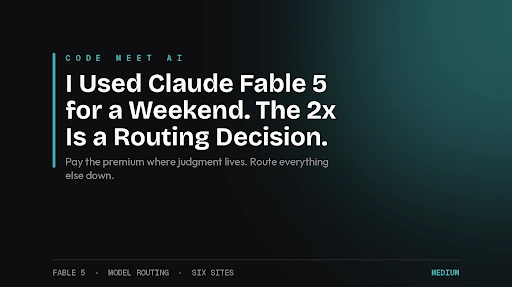
At $10 per million input tokens and $50 per million output tokens, Fable 5 is roughly five times more expensive than Claude Sonnet 4.6 for output. Multi-agent workflows that fan out five sub-agents, each consuming their own context window, can easily burn through hundreds of dollars per session. Without deliberate cost engineering — model routing that sends routine work to cheaper models, sub-agent scoping that minimizes token consumption, caching strategies that avoid redundant context loading — Fable 5 deployments become economically unsustainable.
The engineers who understand how to route queries intelligently — sending Fable-worthy problems to Fable and everything else to Sonnet or Haiku — while maintaining quality across the routing boundary are extremely scarce.
- Refusal and Fallback Handling
Fable 5’s safety classifiers can decline requests that they deem security-sensitive, automatically routing those queries to Opus 4.8 instead. This is a new architectural pattern that didn’t exist with previous models. Your integration needs to handle refusal responses gracefully — detecting when a query was rerouted, managing billing differences between models (you’re not charged Fable prices for rerouted requests), and ensuring the user experience doesn’t break when the model silently changes underneath.
Building robust fallback logic — server-side fallbacks using Anthropic’s new fallbacks parameter, client-side middleware, or manual routing — requires engineering expertise specific to Fable 5’s architecture.
- Multi-Day Session Management
Fable 5 can work for days. But managing a multi-day autonomous AI session in a production environment introduces challenges that single-prompt interactions never faced. Session persistence across server restarts. Checkpoint and recovery when sessions fail mid-task. Progress tracking and human oversight for autonomous work that spans multiple business days. Context management as sessions grow to consume significant portions of the one-million-token context window.
These are operational engineering challenges that most AI teams have never encountered, because no previous model was capable of sustaining this kind of extended autonomous work.
- Governance for Mythos-Class Models
Fable 5 is the most capable model ever made publicly available — so capable that the US government applied export controls within three days of its release. The governance implications are proportionally serious. Audit trails for autonomous decisions. Compliance documentation for multi-day sessions where the AI is making choices without human approval at every step. Data retention policies (Anthropic requires 30-day retention for all Fable 5 interactions). Access controls and usage monitoring to ensure the model is being used within your organization’s risk parameters.
For regulated industries — fintech, healthcare, insurance — the governance engineering required to deploy Fable 5 responsibly is as complex as the application engineering itself.
The Fable 5 Trap: Power Without the Team to Wield It
Here’s the scenario playing out at hundreds of companies right now:
The engineering lead reads the Fable 5 announcement. They see Stripe overhauling 50 million lines of code in a day. They see the benchmark results. They see the autonomous multi-day capabilities. They get excited. They tell leadership: “This changes everything. We should be using this.”
Leadership agrees. Budget is allocated. A Fable 5 deployment is added to the Q3 roadmap.
And then the engineering team opens the documentation and realizes that “using Fable 5” in a production context requires agent harness architecture, sub-agent orchestration design, MCP integration, cost engineering, refusal handling, session management, and governance infrastructure that nobody on the team has ever built.
The prototype works brilliantly. The production deployment stalls. The demo impresses the board. The shipping date slips. The model is powerful. The team isn’t equipped to harness that power.
This is the Fable 5 trap: a model so capable that it creates the illusion that the hard part is done, when in reality the hard part — operationalization — is just beginning.
How gNxt Systems Turns Fable 5 Capability Into Production Reality

This is what gNxt Systems does. Not in theory. In practice, right now, for companies that are staring at Fable 5’s capabilities and asking “how do we actually use this?”
If you need Fable 5 operationalized end-to-end: Our in-house agentic AI team designs and deploys the full production stack — agent harness architecture, sub-agent orchestration, MCP integration, cost routing, refusal handling, session management, governance infrastructure. You bring the use case. We deliver the system. Your team gets full documentation and knowledge transfer.
If your team needs Fable 5 expertise embedded: We place augmented specialists — agent harness architects, cost engineers, MCP integration specialists, AI governance engineers — directly into your team within one to two weeks. They build alongside your engineers, transfer knowledge as they go, and roll off when the deployment is stable.
If you need to build Fable 5 capability in-house permanently: Our AI Team Development model combines execution, knowledge transfer, and hiring support to build your team’s ability to operationalize frontier models — not just Fable 5, but whatever ships next.
Because that’s the final point worth making: Fable 5 won’t be the most powerful model for long. Anthropic will ship something more capable. So will OpenAI. So will Google. The companies that win aren’t the ones that get excited about each new model release. They’re the ones that have the engineering team — or the engineering partner — to operationalize whatever’s coming, as fast as it arrives.
Fable 5 is extraordinary. But it’s a tool. And the most powerful tool in the world is useless without the hands that know how to use it.
Frequently Asked Questions (FAQs)
Q1. What is Claude Fable 5 and why is it significant?
Q2. Why can't most AI teams operationalize Fable 5 without additional expertise?
Q3. How expensive is Fable 5 in production, and how do you manage costs?
Q4. How can gNxt Systems help operationalize Fable 5?
Q5. Should we wait to see how Fable 5 stabilizes before investing in operationalization?
References & Sources
- Anthropic — “Claude Fable 5 and Claude Mythos 5” (June 9, 2026) — https://www.anthropic.com/news/claude-fable-5-mythos-5
- Anthropic — “Redeploying Claude Fable 5” (June 30, 2026) — https://www.anthropic.com/news/redeploying-fable-5
- Anthropic — “Claude Fable” (July 1, 2026) — https://www.anthropic.com/claude/fable
- Axios — “Anthropic’s Fable 5 Is Back After the Trump Administration Lifted Export Controls” (July 1, 2026) — https://www.axios.com/2026/07/01/anthropic-fable-5-back-online-trump-export-controls-lifted
- Forbes — “Claude Fable 5 Extends by Five More Days: 10 Moves to Make Now” (July 7, 2026) — https://www.forbes.com/sites/sandycarter/2026/07/07/claude-fable-5-extends-by-five-more-days-10-moves-to-make-now/
About Author

CEO at gNxt Systems
with 25+ years of expertise, Mr. Anoop Jain delivers complex projects, driving innovation through IT strategies and inspiring teams to achieve milestones in a competitive, technology-driven landscape.
Table of ContentsToggle Table of ContentToggle