- June 10, 2026
- by Anoop Jain
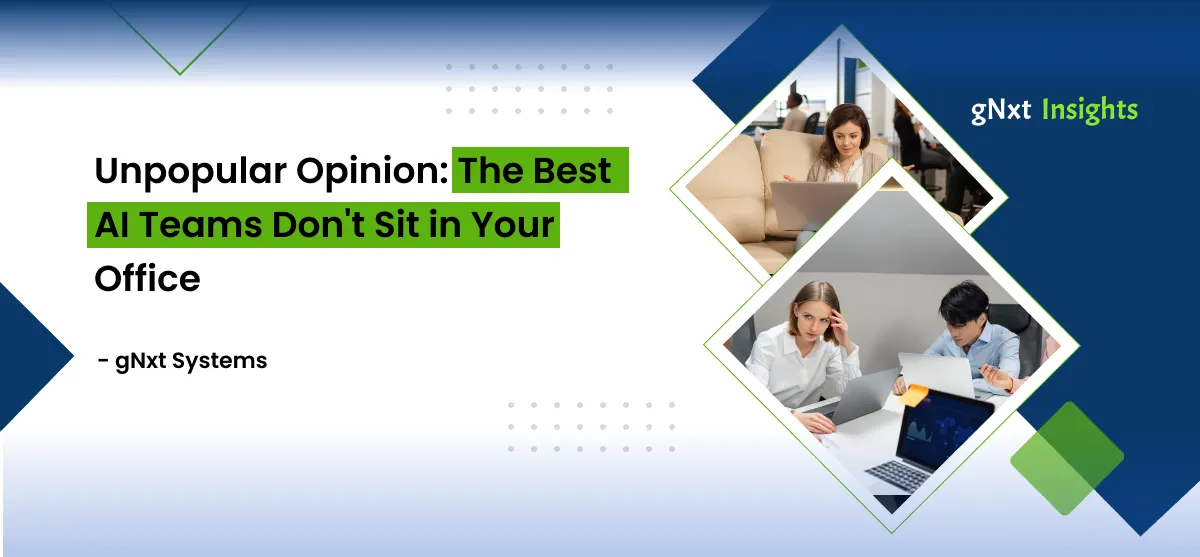
Unpopular Opinion: The Best AI Teams Don’t Sit in Your Office
Say This in a Leadership Meeting. Watch the Room Flinch.
“The best AI team you’ll ever have won’t share your zip code.”
Say that to a CEO who just signed a twelve-month lease on expanded office space. Say it to a VP of Engineering who spent seven months recruiting a local ML engineer. Say it to an HR director who’s measuring success by butts-in-seats and badge swipes. Watch the discomfort.
Because the assumption — unquestioned, unchallenged, and deeply embedded in enterprise culture — is that important work happens in the building. The more strategic the work, the more it needs to be “in-house.” The more critical the talent, the closer they should sit to the decision-makers. And AI, being the single most strategic technology investment most companies will make this decade, must therefore be built by people you can see from your desk.
This assumption is wrong. Not slightly wrong. Structurally, measurably, provably wrong.
And the companies that let go of it first are the ones consistently outperforming on AI delivery — shipping faster, spending less, and accessing better talent than the ones still insisting that proximity equals productivity.
The Proximity Bias That’s Throttling Your AI Roadmap
Let’s name the bias directly: most enterprises operate on an implicit belief that colocation produces better outcomes. That being in the same room leads to better collaboration, faster decisions, and higher-quality work.
For some kinds of work, there’s truth in that. Early-stage product brainstorming, relationship-heavy client work, and culture-building rituals all benefit from physical presence.
AI engineering is not that kind of work.
AI engineering in 2026 is deep technical work that requires sustained concentration, asynchronous collaboration across specialized disciplines, and access to a talent pool that is — by definition — global and sparse. The skills that matter most right now — agent orchestration, MCP integration, evaluation design, production observability — exist in a talent pool so small that restricting your search to commuting distance of your office is like fishing in a puddle when the ocean is right there.
And the data supports this. Remote hiring gives companies access to a 340% larger talent pool compared to local-only recruitment. Companies with distributed teams report up to 19% higher revenue from innovation compared to office-bound teams. Remote workers earn 12–35% more than on-site peers, which tells you where the strongest talent is choosing to work — and it’s not in your open-plan office.
The proximity bias doesn’t just limit your talent pool. It actively selects against the best candidates. The engineers with the most current, most in-demand AI skills — the ones who’ve built production agentic systems, deployed MCP servers, designed evaluation frameworks — are overwhelmingly working remotely. They chose remote because the work supports it, the tools enable it, and the companies competing hardest for their skills offer it. If your AI hiring strategy requires relocation or daily office presence, you’re filtering out the majority of the talent you actually need.
Why AI Work Is Uniquely Suited to Distributed Teams
The argument for distributed AI teams isn’t just about access to talent — though that alone would be sufficient. It’s about the nature of AI work itself.
AI engineering is deep work, not meeting work. Building a multi-agent orchestration system requires hours of uninterrupted concentration. Designing an MCP server architecture demands sustained focus on complex system interactions. Debugging an evaluation framework requires the kind of flow state that open offices actively destroy. The most productive AI engineers don’t need to be in a room with you. They need to be left alone, with clear objectives and the tools to execute.
AI projects are phase-based, not continuous. You don’t need the same team composition for every phase of an AI initiative. A 90-day agentic sprint needs an AI architect and an MCP engineer. A subsequent deployment phase needs an MLOps specialist. A compliance sprint needs a governance engineer. The idea that all of these people should be permanent, colocated employees is an artifact of how we staffed 20th-century work — not how 21st-century AI delivery actually functions.
AI skills are global by nature. The frontier of AI is not concentrated in any single city or geography. The engineer who built the best MCP server implementation you’ve ever seen might be in Bangalore. The agentic AI architect who’s deployed multi-agent systems across three fintech companies might be in Warsaw. The MLOps specialist who’s reduced deployment failures by 60% at their last engagement might be in São Paulo. If you limit your search to a 50-kilometer radius around your headquarters, you’re choosing geography over capability. And in AI, capability wins.
The collaboration tools caught up. The historical case against remote teams was that collaboration suffered. In 2026, that argument has collapsed. AI-powered collaboration tools now handle meeting summaries, project tracking, and coordination across time zones. Code review happens asynchronously through pull requests. Architecture decisions are documented in shared repositories. Pair programming happens over screenshare as effectively as it does in person. The tooling gap that once penalized distributed teams has been eliminated — and in many cases, reversed into an advantage, because distributed teams are forced to document everything, creating institutional knowledge that colocated teams often leave trapped in hallway conversations.
The “Culture” Argument — And Why It Doesn’t Apply
The most common pushback against distributed AI teams is culture. “We need people in the office for culture.” “Our team’s creativity comes from whiteboard sessions.” “You can’t build trust through a screen.”
Let’s unpack this, because it sounds compelling but crumbles under scrutiny in the AI context.
Culture isn’t proximity. Culture is shared values, clear communication, mutual respect, and the ability to trust your teammates to do excellent work. None of those things require sharing an office. They require intentional leadership, transparent processes, and defined norms — all of which are achievable in distributed settings and, frankly, often absent in colocated ones.
The best AI culture isn’t built around ping pong tables and catered lunches. It’s built around code quality, rigorous evaluation, clean documentation, knowledge sharing, and the freedom to do deep work without interruption. Those values are not only compatible with distributed teams — they’re often stronger in them, because distributed teams can’t rely on physical presence as a proxy for contribution. The work speaks for itself.
And here’s the uncomfortable truth most leaders won’t say out loud: for AI specialists earning $200K+ and commanding multiple offers, the “culture” of your office isn’t a draw. It’s a constraint. They’ve experienced remote work. They know they’re more productive in it. They value the flexibility. Requiring them to commute isn’t a culture play — it’s a filter that removes your strongest candidates.
What the Best AI Teams Actually Look Like in 2026
The companies consistently winning at AI delivery in 2026 — the ones shipping production agentic systems, deploying MCP-connected architectures, and meeting compliance deadlines — share a team structure that looks nothing like the traditional engineering org chart.
A small, permanent core that owns context and strategy. Three to five engineers who know the business, the data, and the long-term vision. They might sit in the office. They might not. What matters is they have deep institutional knowledge and the authority to make architectural decisions. These are the thread of continuity that holds the AI roadmap together.
A distributed augmented layer that provides frontier execution. Specialized engineers embedded into the team for defined phases of work — agentic AI architects, MCP integration engineers, MLOps specialists, evaluation designers, governance engineers. They join via the same collaboration tools the rest of the team uses. They attend the same standups. They submit PRs through the same review process. They’re functionally indistinguishable from “internal” team members — except they bring skills the internal team doesn’t have, and they’re available in two weeks instead of six months.
A knowledge transfer pipeline that makes the core team stronger. Every augmented engagement includes pair programming, documentation, workshops, and structured handoffs. The distributed specialists don’t just build systems — they teach. When they roll off, the core team owns everything and has leveled up their skills for the next initiative.
This model is distributed by design. The core team might be in Delhi. The agentic AI architect might be in Berlin. The MCP engineer might be in Toronto. The MLOps specialist might be in Hyderabad. They work in different time zones, often asynchronously, and the output is consistently superior to what any single-location team could produce — because it’s assembled for capability, not convenience.
The Hidden Advantages Nobody Talks About
Beyond talent access and speed, distributed AI teams unlock advantages that most companies don’t realize until they experience them.
Cross-pollinated expertise. An augmented specialist who’s built agentic systems at a fintech, a healthcare company, and an e-commerce platform brings pattern recognition that no insular, colocated team can develop. They’ve seen what works and what doesn’t across industries, tech stacks, and organizational contexts. That breadth of exposure is enormously valuable in a field that’s reinventing itself every quarter.
Forced documentation discipline. Distributed teams can’t rely on “ask the person at the next desk.” Everything gets documented — architecture decisions, deployment procedures, evaluation criteria, operational runbooks. This creates institutional knowledge that persists even when team members rotate. Colocated teams often have critical knowledge trapped in individual heads. Distributed teams can’t afford that luxury, so they don’t have that vulnerability.
Time zone coverage. A well-structured distributed team can have work progressing across multiple time zones — code reviewed in one zone while it’s written in another, deployments monitored around the clock without anyone working overnight. This isn’t just efficiency. It’s a genuine operational advantage for production AI systems that need continuous oversight.
Reduced groupthink. Diverse perspectives — across geographies, cultures, and organizational experiences — produce better technical decisions. The team that’s all from the same university, the same city, and the same company tends to converge on solutions that feel comfortable rather than solutions that are optimal. Distributed teams naturally introduce cognitive diversity that challenges assumptions and improves outcomes.
Zero bench waste. In a colocated in-house model, you’re paying full-time salaries for specialists who may be intensely needed for three months and underutilized for the next six. In a distributed augmented model, specialists engage for defined phases and roll off when the work is done. No bench costs. No idle payroll. Every dollar goes toward active delivery.
How gNxt Systems Builds the Best AI Teams — Without an Office
At gNxt Systems, distributed AI teams aren’t a compromise. They’re the product.
Our specialist network spans AI engineers, agentic AI architects, MCP integration specialists, MLOps engineers, evaluation designers, AI governance experts, prompt engineers, data engineers, and AI product managers — all with documented production experience, all working in distributed models, all capable of embedding into your team within one to two weeks.
We don’t send people to your office. We embed them in your workflow. Same standups. Same codebase. Same Slack channels. Same code review process. The only thing that’s different is that we’re selecting from a global talent pool instead of a local one — which means we’re matching on capability, not commute time.
Every engagement includes knowledge transfer as a formal deliverable. Your internal team doesn’t just get a system built. They get stronger. Pair programming, architecture documentation, operational runbooks, structured handoff workshops. When our specialists roll off, your team owns everything — the code, the knowledge, and the confidence to extend it.
Whether you need a single specialist for a focused sprint, a full augmented squad for an end-to-end initiative, or help building permanent in-house capability from scratch — we assemble the right team for the right work, regardless of where they sit.
Because the best AI team you’ll ever have isn’t defined by where they work. It’s defined by what they’ve built, what they know, and how fast they can move.
The Real Question
The question isn’t whether distributed AI teams work. They do. The data proves it. The companies winning at AI prove it. The talent market — where the best engineers overwhelmingly choose remote — proves it.
The real question is whether your organization is willing to update its assumptions fast enough to compete.
The companies clinging to “everyone in the office” are selecting from a shrinking, local, increasingly expensive talent pool — and wondering why their AI roadmap keeps slipping. The companies embracing distributed, augmented teams are accessing the global frontier of AI expertise — and shipping while their competitors are still interviewing.
The best AI teams don’t sit in your office. They sit wherever the best talent is. And the companies that figure this out first don’t just build better AI. They build it faster, cheaper, and with capabilities that no single office could ever assemble.
That’s not an unpopular opinion. It’s the 2026 reality that most companies haven’t caught up with yet.
References & Sources
- Gable — “Remote Work Trends 2026: 40+ Statistics Shaping the Future of Work” (April 2026) — https://www.gable.to/blog/post/work-from-home-statistics
- Pydantic — “Remote Work in the Age of AI: Why Distributed Teams Win” (April 2026) — https://pydantic.dev/articles/remote-work-ai-age
- Global Teams AI — “Remote Teams Driving Global Growth in 2026” (February 2026) — https://gteams.ai/blogs/how-remote-teams-drive-global-business-growth/
- Global Teams AI — “How to Manage Remote Teams Effectively in 2026” (May 2026) — https://gteams.ai/blogs/how-to-manage-remote-teams-effectively/
- Glints TalentHub — “Remote Work in 2026: What’s Changing and What Leaders Need to Prepare For” (January 2026) — https://talenthub.glints.com/en-sg/blog/remote-work-trend
Frequently Asked Questions (FAQs)
Q1. Why are distributed AI teams more effective than colocated ones?
Q2. How do you maintain quality and collaboration with a distributed AI team?
Q3. What about security and IP concerns with distributed AI engineers?
Q4. How do augmented distributed AI specialists transfer knowledge to our internal team?
Q5. Is a distributed AI team model more cost-effective than building a colocated in-house team?
About Author

CEO at gNxt Systems
with 25+ years of expertise, Mr. Anoop Jain delivers complex projects, driving innovation through IT strategies and inspiring teams to achieve milestones in a competitive, technology-driven landscape.
Table of ContentsToggle Table of ContentToggle