- May 21, 2026
- by Anoop Jain
Every Company Wants AI Agents. Nobody Can Hire the Engineers to Build Them
Every enterprise wants AI agents. The numbers leave zero room for debate.
Seventy-nine percent of companies report that AI agents are already being adopted within their organizations. Forty percent of enterprise applications will embed task-specific AI agents by the end of 2026 — up from less than 5% in 2024. Eighty-eight percent of executives plan to increase their AI budgets specifically because of agentic AI. Ninety-seven percent of executives say their company deployed AI agents in the past year.
The agentic AI market hit $10.86 billion in 2026, up from $7.55 billion just a year earlier. It’s projected to reach $236 billion by 2034. Organizations deploying agentic AI at production scale are seeing a median ROI of 171% globally — with top-quartile performers exceeding 540% within eighteen months.
The demand is universal. The budget is approved. The executive mandate is signed.
And then everyone hits the same wall.
Who’s going to build it?
Not the data scientist who’s great at modeling but has never orchestrated multi-agent workflows. Not the backend engineer who can build APIs but doesn’t understand tool-calling architectures, MCP servers, or guardrail design. Not the prompt engineer who can write impressive demos but has never shipped an autonomous system that handles real transactions in a regulated environment.
The talent to build production-grade agentic AI systems is the scarcest resource in enterprise technology right now. And the gap between the companies that have it and the companies that don’t is quickly becoming the gap between market leaders and everyone else.
Why Agentic AI Is a Different Kind of Build
The reason companies can’t just repurpose their existing AI teams for agentic projects isn’t a matter of effort. It’s a matter of discipline. Agentic AI is architecturally, operationally, and philosophically different from everything that came before it in enterprise AI.
A traditional AI system responds to prompts. A chatbot answers questions. A recommendation engine suggests products. A fraud model scores transactions. These are request-response systems — a human asks, the AI answers.
Agentic AI doesn’t wait to be asked. It plans. It reasons about goals. It breaks complex objectives into steps. It discovers and uses tools autonomously. It connects to enterprise systems through protocols like MCP, reads data, makes decisions, takes actions, and adapts when things don’t go as planned — often without a human in the loop at every stage.
Building this requires skills that most engineering teams simply don’t have.
Multi-agent orchestration — how do you design a system where specialized agents collaborate, delegate to each other, and resolve conflicts when their goals compete? Tool-calling architecture — how do agents discover available tools, evaluate which is appropriate, and use them correctly? Guardrail engineering — how do you prevent an autonomous system from taking actions that are dangerous, expensive, or non-compliant? Memory and state management — how do agents maintain context across complex, multi-step workflows? Human-in-the-loop design — when should an agent act independently, and when must it escalate to a human? MCP integration — how do agents connect securely to enterprise databases, CRMs, APIs, and internal systems?
These aren’t skills you pick up from a weekend course. They’re disciplines that require hands-on experience building, deploying, debugging, and operating autonomous systems in production environments. And that experience pool is vanishingly small — because the entire discipline is barely a year old.
The result is a market where every company has agentic AI on their roadmap, 79% are adopting in some form, but only 11% have an agent actually running in production. That 68-percentage-point gap — the largest deployment backlog in enterprise technology history — is overwhelmingly a talent gap.
The Talent Bottleneck Nobody Can Solve Alone
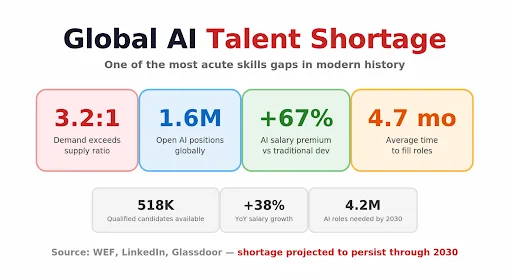
Let’s be specific about the scale of this problem.
The global AI talent shortage sits at 3.2 open roles for every qualified candidate across general AI positions. For agentic AI specialists — engineers with production experience in multi-agent orchestration, MCP integration, and autonomous system deployment — the ratio is dramatically worse. These roles didn’t exist eighteen months ago. There are no university programs producing agentic AI architects. No established bootcamps with meaningful rigor. The engineers who have this experience gained it by building at the frontier, and they number in the low thousands globally.
Meanwhile, the companies trying to hire them number in the hundreds of thousands.
Over 40% of agentic AI projects are at risk of cancellation by 2027 if governance, observability, and talent gaps aren’t addressed. Skills and talent gaps affect 29–60% of organizations attempting to scale beyond initial prototypes. The integration complexity alone — enterprise technology landscapes involve 50–200+ systems requiring connection — means that even well-funded teams with strong general engineering talent routinely stall when they encounter the specialized demands of production agentic deployment.
Traditional hiring can’t fix this at any speed. The average time to fill a senior AI role is four to six months. For agentic AI specialists, it’s often longer — because recruiters can’t identify the skills, HR departments have never seen the job titles, and the candidate pool is so small that your listing is competing with every other enterprise that’s had the same realization.
This is where companies need to think differently. Not about whether to build agentic AI — that decision is already made. But about how to get the talent to actually do it.
How gNxt Systems Solves the Agentic AI Talent Problem — Three Ways

At gNxt Systems, we’ve watched the agentic AI wave build for over a year. We saw the talent gap forming before most companies even had agentic AI on their roadmaps. And we built three distinct capabilities to close it — because we know that different organizations need different approaches.
Whether you want a turnkey agentic AI solution built for you, specialized engineers embedded into your existing team, or help building permanent in-house agentic capability from scratch — gNxt Systems has the model that fits.
Path 1: We Build It for You — gNxt’s In-House Agentic AI Solutions
Not every company wants to hire agentic AI engineers. Some want the system — built, tested, deployed, and running in production — without assembling the team themselves.
That’s exactly what gNxt Systems’ in-house Agentic AI Solutions practice delivers.
We maintain a dedicated, battle-tested team of agentic AI architects, AI agent engineers, MCP integration specialists, MLOps engineers, and AI governance experts who’ve built production autonomous systems across fintech, healthcare, enterprise SaaS, retail, and manufacturing. They don’t learn on your project. They bring the accumulated experience of dozens of prior deployments.
What this looks like in practice:
You come to us with a business problem — not a technical specification. “We need an autonomous customer onboarding system that guides new users through setup and configuration.” “We need AI agents that handle first-line customer support, route complex cases, and learn from resolutions.” “We need an intelligent procurement agent that monitors supplier pricing, flags anomalies, and generates purchase orders autonomously.”
Our team takes it from there. Architecture design. Agent orchestration. MCP server buildout connecting agents to your enterprise systems. Guardrail engineering. Testing and evaluation. Production deployment. Monitoring and observability. Compliance documentation.
You get a production-grade agentic AI system — fully operational, fully documented, fully transferable — without hiring a single specialist.
This path is ideal when: You need agentic AI capability but don’t want to build or manage an AI team. You have a clear business problem and want it solved, not staffed. You’re on a tight timeline and need a team that’s already worked together, already has established workflows, and can execute from day one.
Path 2: We Augment Your Team — AI & ML Staff Augmentation
You have an engineering team. They’re strong. They understand your business, your data, your systems. But they don’t have production experience in multi-agent orchestration, MCP integration, or autonomous system deployment — and hiring is taking months.
gNxt Systems’ AI Staff Augmentation model embeds pre-vetted agentic AI specialists directly into your existing team. Same standups. Same codebase. Same code review process. Same Slack channels. They’re not vendors in a silo. They’re teammates with the specific expertise your team needs right now.
What this looks like in practice:
Your engineering lead identifies the agentic initiative on the roadmap and the specific skill gaps blocking execution. We match you with two to three pre-vetted specialists — say, an agentic AI architect and an MCP integration engineer — who’ve built exactly what you’re building, at companies similar to yours. You interview them. You choose. Within one to two weeks, they’re onboarded and contributing.
They execute against defined deliverables — designing the agent orchestration layer, building the MCP servers, implementing guardrails, deploying to production. And they transfer knowledge every step of the way. Pair programming with your engineers. Documenting architecture decisions. Running structured handoff sessions. When they roll off — typically after 60 to 120 days for agentic sprints — your team doesn’t just have a working system. They have the understanding to maintain, extend, and evolve it.
This path is ideal when: You have a capable internal team that needs specific agentic AI expertise to unblock a roadmap initiative. You want to maintain full control over architecture and direction while accessing frontier skills. You want your internal team to get stronger through the engagement, not just get a deliverable.
Path 3: We Help You Build Your Own Team — In-House AI Team Development
Some organizations want to build permanent, long-term agentic AI capability — a dedicated in-house team that owns the discipline for years to come. But they don’t know where to start. What roles to hire. What skills to screen for. How to structure the team. How to ramp them up on a discipline that barely existed a year ago.
gNxt Systems’ AI Team Development model solves this cold-start problem. We combine augmented specialists, structured knowledge transfer, team design advisory, and hiring support to help you build an agentic AI team from scratch — one that’s genuinely self-sufficient.
What this looks like in practice:
We start by working with your engineering leadership to define the target team structure — which roles you need permanently, which skills are phase-specific, and how the team should interface with your broader engineering organization. Then we embed augmented specialists who execute on your first agentic initiative while simultaneously training and mentoring your incoming permanent hires. As your internal team ramps, the augmented specialists progressively hand off responsibilities. By the end of the engagement, your in-house team isn’t starting from zero. They’ve already shipped a production system, they understand the architecture they’ll own, and they have operational runbooks and documentation for everything.
We can also support your hiring process directly — helping you write technically accurate job descriptions for agentic roles, screening candidates against the skills that actually matter (not the ones that look good on a resume), and providing technical assessment frameworks.
This path is ideal when: You want permanent, in-house agentic AI capability for the long term. You need help defining the right team structure and roles. You want your first hires to be productive immediately, not spending their first six months figuring out what to build.
Why gNxt Systems — Not Just Any Partner
The agentic AI talent market is attracting every staffing firm and consultancy that sees an opportunity. Many of them are repackaging traditional software engineers as “AI specialists” and hoping nobody notices. That approach fails — expensively and visibly — when it hits the complexity of production agentic systems.
gNxt Systems is different because we’ve been building in this space since before most companies knew it existed.
Our agentic AI team has production deployment experience. Not demos. Not prototypes. Not conference presentations. Production systems handling real transactions, real customer interactions, and real compliance obligations. They’ve built multi-agent orchestration layers, deployed MCP servers connecting agents to enterprise infrastructure, engineered guardrails for autonomous systems in regulated environments, and operated these systems at scale.
We staff the full agentic stack. Agentic AI Architects. AI Agent Engineers. MCP Integration Engineers. MLOps Engineers. AI Governance Engineers. Prompt Engineers. AI Solutions Architects. AI Infrastructure Engineers. Data Engineers. AI Product Managers. Whatever your initiative needs — a single specialist or a full squad — we match the talent to the work.
Knowledge transfer is built into everything we do. Whether we’re building a system for you, augmenting your team, or helping you build your own — every engagement is designed to leave your organization more capable than we found it. Documentation, runbooks, paired sessions, workshops, and structured handoffs aren’t afterthoughts. They’re deliverables.
We understand regulated industries. Fintech. Healthcare. Insurance. Enterprise SaaS. Our engineers work within PCI-DSS, SOC 2, HIPAA, GDPR, and EU AI Act compliance frameworks. Agentic AI in regulated environments demands more than technical skill — it demands engineers who understand that an autonomous agent making decisions in a financial system has compliance implications that a chatbot doesn’t.
The Window Is Closing
Here’s the uncomfortable math.
Seventy-nine percent of enterprises have adopted AI agents in some form. But only 11% have an agent running in production. That 68-point gap is the largest deployment backlog in enterprise technology history.
The companies that close it first will capture disproportionate competitive advantage. The median payback period for production agentic deployments is 5.1 months. The median ROI is 171%. Top performers exceed 540%. These aren’t projections — they’re actuals from organizations that found the talent to execute.
The companies that don’t close it will face a different reality. Over 40% of agentic AI projects are at risk of cancellation by 2027 if the talent and governance gaps aren’t addressed. Not because the technology failed. Because the team wasn’t there to build it.
You don’t have to be in that 40%.
Whether you need a turnkey agentic AI solution from our in-house team, augmented specialists embedded in yours, or help building permanent in-house capability — gNxt Systems gives you the talent to actually build what everyone’s talking about.
The agents aren’t going to build themselves. But the right team will.
References & Sources
- Digital Applied — “AI Agent Adoption 2026: 120+ Enterprise Data Points” (April 2026) — https://www.digitalapplied.com/blog/ai-agent-adoption-2026-enterprise-data-points
- Cyntexa — “Agentic AI Statistics 2026: Adoption, Market Size, Challenges & More” (February 2026) — https://cyntexa.com/blog/agentic-ai-statistics/
- OneReach AI — “Agentic AI Stats 2026: Adoption Rates, ROI, & Market Trends” (April 2026) — https://onereach.ai/blog/agentic-ai-adoption-rates-roi-market-trends/
- Writer — “Enterprise AI Adoption in 2026: Why 79% Face Challenges Despite High Investment” (May 2026) — https://writer.com/blog/enterprise-ai-adoption-2026/
- FifthRow — “Agentic AI’s Enterprise Tipping Point: How April 2026 Redefined Production-Scale Adoption” (May 2026) — https://www.fifthrow.com/blog/agentic-ai-s-enterprise-tipping-point-how-april-2026-redefined-systematic-innovation-and-production-scale-adoption
Frequently Asked Questions (FAQs)
Q1. What is agentic AI, and why is every enterprise trying to build it?
Q2. Why is it so hard to hire engineers who can build AI agents?
Q3. Can gNxt Systems build an agentic AI solution for my company end-to-end?
Q4. How does gNxt Systems' AI staff augmentation work for agentic AI projects?
Q5. Can gNxt Systems help us build a permanent in-house agentic AI team from scratch?
About Author

CEO at gNxt Systems
with 25+ years of expertise, Mr. Anoop Jain delivers complex projects, driving innovation through IT strategies and inspiring teams to achieve milestones in a competitive, technology-driven landscape.
Table of ContentsToggle Table of ContentToggle