- April 6, 2026
- by Anoop Jain
The Biggest Lie in AI Hiring? That You Need to Build an In-House Team
The Story Everyone Believes
Walk into any leadership meeting where AI is on the agenda and you’ll hear the same refrain: “We need to hire our own AI team.” It’s become gospel. Build the team. Own the talent. Keep the IP close.
On the surface, it makes perfect sense. AI is strategic. It touches revenue, product, operations, customer experience. Why would you hand that to outsiders?
Here’s the problem: this thinking assumes a world where AI talent is abundant, affordable, and patient enough to sit through your six-round interview process. That world doesn’t exist anymore.
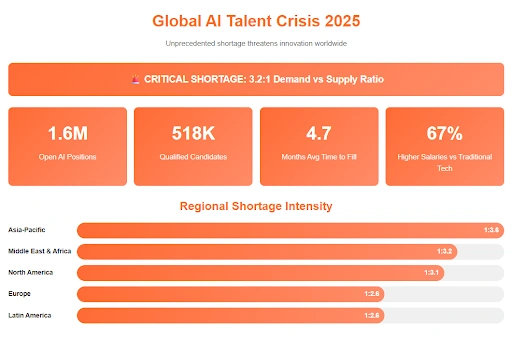
The reality in 2026 is stark. The demand-supply gap for qualified AI professionals has widened to roughly three open roles for every available candidate. Salaries for experienced GenAI engineers in the US have climbed past $200K annually, and they’re still rising at double-digit rates year over year. The handful of specialists who can actually architect production-grade agentic systems or fine-tune foundation models? They’re fielding five offers before your recruiter has even scheduled a screening call.
The in-house AI team isn’t a bad idea. It’s an incomplete one. And the companies treating it as the only idea are paying for that rigidity with something they can’t get back: time.
Why the “Build It All Internally” Playbook Is Breaking
The traditional hiring model was built for stable, predictable roles. You identify a need, write a job description, run a search, make a hire, onboard, and ramp. For most functions, this works reasonably well.
AI doesn’t follow that pattern.
AI development moves in phases — research and prototyping, model training, production deployment, monitoring, governance, iteration. Each phase demands different skill sets, different intensity levels, and different timelines. You might need three MLOps engineers for four months during deployment, then zero for the next six. You might need a prompt engineering specialist for a single product launch. You might need an AI ethics and compliance lead specifically because regulatory deadlines are approaching, not because you need that role permanently.
Hiring full-time for every one of these needs is like buying a house in every city you travel to. Technically possible if you have unlimited money. Strategically absurd for everyone else.
And then there’s the speed problem. AI moves at a pace that makes traditional hiring look like it’s running through wet cement. The frameworks, tools, and best practices that mattered six months ago may already be outdated. A job description written in January might be irrelevant by July. The candidates you’re evaluating today were trained on yesterday’s stack.
Companies that insist on building everything internally aren’t just spending more — they’re moving slower. And in AI, slow is expensive
The Rise of AI Staff Augmentation (And Why It’s Not What You Think)
When most people hear “staff augmentation,” they picture a body shop. Warm seats. Generic contractors filling generic roles. That perception is outdated and, frankly, dangerous — because it causes leaders to dismiss a model that is quietly becoming the dominant strategy among the fastest-moving AI organizations.
Modern AI and ML staff augmentation is something fundamentally different. It’s about surgically embedding senior, specialized talent into your existing teams for defined outcomes. Not replacing your people. Amplifying them.
Think of it this way: your internal engineering team understands your business, your data, your customers. What they may not have is deep experience deploying retrieval-augmented generation at scale, or building evaluation frameworks for LLM outputs, or navigating the compliance requirements of the EU AI Act. An augmented AI specialist brings that precise expertise, works within your workflows, transfers knowledge to your team, and rolls off when the job is done.
This isn’t outsourcing your AI strategy. It’s giving your strategy the hands and brains it needs to actually execute.
The most sophisticated companies in the GenAI staffing space — firms like gNxt Systems — operate more like talent architecture partners than staffing agencies. They map your capability gaps against your AI roadmap, identify where permanent hires create long-term leverage, and fill the gaps between with specialists who’ve done the exact work you need, at the exact stack level you need it.
The Real Cost Equation Nobody Talks About
Here’s a conversation that happens far too rarely: what is the actual, fully-loaded cost of building an in-house AI team from scratch?
Most leaders think about salary. Maybe benefits. Perhaps a recruiter fee. But the real cost iceberg goes much deeper.
There’s the opportunity cost of the four to six months it takes to fill a senior AI role — months where your project sits idle or moves at a fraction of its potential speed. There’s the ramp-up period, because even a brilliant hire needs two to three months to understand your data architecture, your deployment environment, and your business logic. There’s the retention risk, because AI professionals are among the most aggressively recruited people on the planet, and your six-month hire might become someone else’s seven-month hire.
And then there’s the cost nobody puts on a spreadsheet: the wrong hire. An AI engineer who’s technically competent but wrong for your specific problem. Someone who excels at research but struggles with production systems. A contractor-quality performer disguised in a full-time package. These misalignments don’t just waste salary — they can derail an entire initiative by months.
AI staff augmentation doesn’t eliminate all of these risks, but it fundamentally restructures them. Engagements are scoped. Timelines are defined. Performance is visible quickly because the work is tied to deliverables, not just attendance. And if a specialist isn’t the right fit, the correction happens in days, not months.
The math usually becomes obvious once you actually run it. For many companies, a focused three-month augmentation engagement delivers more production-ready AI capability than a twelve-month internal hiring cycle.
What the Smartest Companies Are Actually Doing
The companies leading in AI adoption aren’t choosing between in-house teams and augmented talent. They’re doing both — deliberately and strategically.
The pattern looks something like this: a lean, permanent AI core team owns strategy, governance, and institutional knowledge. They’re the keepers of the vision. Around that core, augmented specialists rotate in and out based on project phases — a fine-tuning expert for model optimization, an MLOps engineer for deployment infrastructure, a data annotation lead for training pipeline quality, a compliance specialist as regulatory milestones approach.
This hybrid model does something that pure in-house teams struggle with: it stays current. Because augmented specialists work across multiple organizations and problem domains, they bring cross-pollinated expertise that an insular team simply can’t develop. They’ve seen what works and what doesn’t across industries, tech stacks, and scale levels. That breadth of exposure is enormously valuable in a field that’s reinventing itself every quarter.
It also solves the bench problem. Every in-house team eventually faces periods where highly paid specialists are underutilized — between projects, waiting for data, blocked by dependencies. Augmentation eliminates that waste entirely. You pay for capability when you need it, and you don’t when you don’t.
GenAI Staffing in 2026: What’s Changed and What Matters Now

The GenAI staffing landscape has matured dramatically even in the past twelve months. Early generative AI projects were experimental — proof of concepts, internal chatbots, simple summarization tools. The talent needed for that work was relatively available.
Now, enterprises are deploying GenAI at the core of products, customer experiences, and operational workflows. The skill requirements have shifted accordingly. Companies aren’t just looking for people who understand large language models conceptually. They need engineers who’ve built production RAG systems end-to-end, who can evaluate and optimize model performance against business KPIs, who understand agentic frameworks and multi-model orchestration, and who can do all of this while keeping costs, latency, and compliance in check.
This level of specialization is exactly where AI staff augmentation shines. These aren’t generalist developers who watched a few tutorials. They’re practitioners who’ve done the specific work before, often multiple times, and can hit the ground running on day one.
The companies that recognize this — that stop trying to recruit unicorns and start assembling the right expertise at the right time — are the ones consistently shipping while their competitors are still interviewing.
How gNxt Systems Approaches AI & ML Staff Augmentation Differently
At gNxt Systems, we don’t believe in filling seats. We believe in filling gaps — the precise capability gaps that stand between your AI vision and your AI reality.
Our approach starts with understanding your roadmap, not just your job descriptions. We map the phases of your AI initiative, identify the skill profiles each phase demands, and then match you with specialists who’ve delivered that exact work before. Whether you need a GenAI architect for a 90-day sprint, a team of ML engineers for a six-month deployment push, or a single AI governance specialist to prepare for regulatory compliance — we build the engagement around your outcomes, not around headcount.
What makes this work is the quality of the talent network. Our specialists aren’t between jobs. They’re professionals who’ve chosen the augmentation model because it lets them work on challenging problems across industries, stay at the cutting edge, and deliver impact without bureaucracy.
The result? Faster time-to-value, lower total cost, knowledge transfer to your internal teams, and the agility to scale up or down as your needs evolve. No twelve-month hiring cycles. No six-figure recruiter fees. No bench costs. Just the right people, doing the right work, at the right time.
The Bottom Line
The lie isn’t that in-house AI teams are worthless. The lie is that they’re sufficient — that hiring full-time is the only legitimate, serious way to build AI capability.
In a market where talent is scarce, skills evolve quarterly, and the cost of delay is measured in lost market position, clinging to a pure in-house model isn’t strategic. It’s stubborn.
The future belongs to organizations that think about AI talent the way they think about AI itself: flexible, modular, and optimized for outcomes rather than optics.
Stop trying to own every capability. Start assembling the right expertise at the right moment. That’s not a shortcut. That’s the strategy.
Frequently Asked Questions (FAQs)
Q1. What is AI staff augmentation, and how is it different from outsourcing?
Q2. How long does it take to hire a GenAI engineer in 2026?
Q3. What GenAI and AI/ML roles are hardest to fill right now?
Q4. Is AI staff augmentation cost-effective compared to building an in-house AI team?
Q5. When should a company use AI staff augmentation instead of hiring full-time?
About Author

CEO at gNxt Systems
with 25+ years of expertise, Mr. Anoop Jain delivers complex projects, driving innovation through IT strategies and inspiring teams to achieve milestones in a competitive, technology-driven landscape.
Table of ContentsToggle Table of ContentToggle