- April 24, 2026
- by Anoop Jain
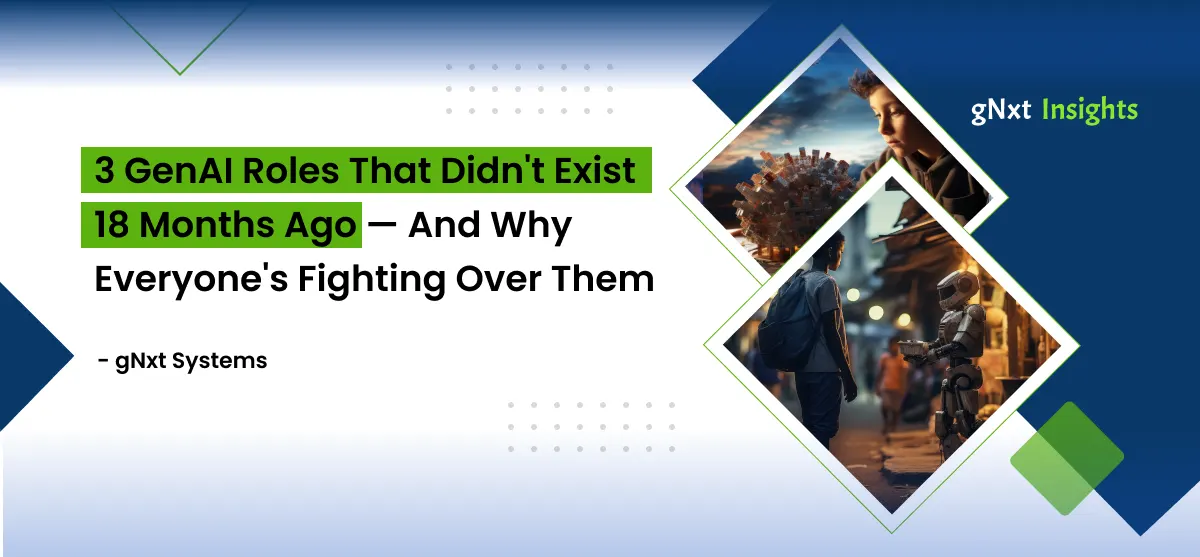
3 GenAI Roles That Didn’t Exist 18 Months Ago — And Why Everyone’s Fighting Over Them
Eighteen months ago — October 2024 — the AI job market looked nothing like it does today. Companies were hiring “machine learning engineers” and “data scientists” and “NLP specialists.” Those were the categories. Those were the LinkedIn filters. Those were the roles recruiters understood.
Today, the three most aggressively recruited AI roles at high-growth companies didn’t have standardized job titles in late 2024. They weren’t taught in university programs. They didn’t appear on salary surveys. Most HR departments had never heard of them.
And right now, in April 2026, these three roles are single-handedly determining which companies ship production AI and which companies keep running pilots that never graduate.
The war for these specialists is unlike anything the tech talent market has seen — not because the salaries are high (though they are), but because the supply is so catastrophically small that traditional hiring is functionally useless. These aren’t roles where you can post a job and wait. They’re roles where, if you don’t have the right staffing strategy, you simply go without.
Here’s what they are, why they matter, and why the companies winning the race aren’t trying to hire them full-time.

Role #1: Agentic AI Architect
What it is: The engineer who designs, builds, and orchestrates autonomous AI agent systems — multi-agent workflows where AI doesn’t just answer questions but plans, reasons, uses tools, makes decisions, and executes complex multi-step processes without human intervention at every stage.
Why it didn’t exist 18 months ago: In October 2024, agentic AI was a research concept and a conference talking point. The frameworks that power today’s agent systems — OpenAI’s Agents SDK, CrewAI, LangGraph, AutoGen — were either in early beta, pre-release, or hadn’t found mainstream adoption. The Model Context Protocol, which has since become the universal standard for connecting AI agents to enterprise tools and data, had recently been open-sourced by Anthropic but hadn’t yet crossed from experimental spec to production infrastructure. There was no such thing as an “agentic AI architect” because there were no production agentic AI systems to architect.
What changed: Everything, in about nine months. MCP crossed 97 million installs by March 2026. The Agentic AI Foundation launched under the Linux Foundation with contributions from Anthropic, OpenAI, and Block. Every major AI provider now ships MCP-compatible tooling. Enterprises went from asking “What is agentic AI?” to putting it on their production roadmaps — with 100% of organizations surveyed reporting agentic AI on their 2026 plans.
The role that emerged from this explosion requires a genuinely unusual skill profile. An agentic AI architect needs to understand multi-agent orchestration patterns — how to decompose a complex business process into a system of specialized agents that collaborate, delegate, and self-correct. They need deep knowledge of tool-calling architectures, progressive discovery, and how to design the guardrails that keep autonomous systems from going off the rails. They need to understand MCP server design, authentication and authorization for AI-to-system connections, and the governance implications of giving AI agents authenticated access to production databases and internal APIs.
They also need something that no framework can teach: judgment about where autonomy is appropriate and where human oversight is essential. In a system where AI agents are making decisions that affect real customers, real transactions, and real compliance obligations, the architectural choices about when an agent should act independently and when it should escalate to a human are as important as the code itself.
Why everyone’s fighting over them: Because agentic AI is no longer optional — it’s the primary way enterprises are deploying AI in 2026. Deloitte’s research makes the shift clear: the first wave of enterprise GenAI was chatbots, which were useful but didn’t transform operations. Agentic AI is the second wave — specialized autonomous systems that execute workflows, not just answer questions. Companies need architects who can build these systems, and the pool of engineers with production agentic experience is minuscule because the entire discipline is barely a year old.
The demand is massive. The supply is measured in hundreds, globally. You can’t hire your way out of that ratio. Not at any salary.
Role #2: MCP Integration Engineer
What it is: The specialist who designs, builds, and maintains the connectivity layer between AI agent systems and enterprise tools — databases, CRM platforms, code repositories, communication systems, internal APIs, and third-party services — using the Model Context Protocol as the foundational standard.
Why it didn’t exist 18 months ago: Because MCP itself was in its infancy. In late 2024, Anthropic had just open-sourced the protocol. There were a handful of experimental implementations. No enterprise was running MCP in production. The concept of a dedicated “MCP integration engineer” would have been meaningless — it would be like posting a job for a “Kubernetes engineer” in 2013 when Docker had just launched.
What changed: MCP crossed the chasm from experiment to infrastructure faster than almost any technology standard in recent memory. By early 2026, every major AI provider — including Google and OpenAI — had adopted the protocol. Thousands of MCP servers were available. Forrester predicted that 30% of enterprise app vendors would launch MCP servers in 2026. The protocol went from “interesting Anthropic project” to “the USB-C of AI” — the universal connector that lets any AI model talk to any data source or tool.
This created an immediate and enormous demand for engineers who understand how to build and operate in the MCP ecosystem. An MCP integration engineer needs to design MCP servers that expose enterprise systems to AI agents with proper semantic contracts — not just wrapping APIs, but creating meaningful interfaces that agents can discover and use intelligently. They need to implement progressive discovery patterns so agents can efficiently find and load the right tools without consuming context with unnecessary definitions. They need to handle the security layer — authentication, authorization, role-based access, and audit trails — that MCP itself doesn’t fully resolve.
The role sits at a unique intersection: deep understanding of enterprise systems architecture on one hand, and intimate knowledge of how AI agents discover, evaluate, and use tools on the other. It requires someone who can think about both the infrastructure side (how does a production database safely expose capabilities to an AI system?) and the AI side (how does an agent decide which of fifty available tools is the right one for this specific task?).
Why everyone’s fighting over them: Because MCP is becoming the foundational infrastructure layer for enterprise AI, and every company deploying agentic systems needs engineers who can build that connectivity. The problem is that the discipline is so new that experience is measured in months, not years. There are no university programs producing MCP specialists. There are no certification courses with meaningful rigor. The engineers who have production MCP experience gained it by being early adopters — by building and breaking things at the frontier.
The total number of engineers worldwide with meaningful production MCP experience is probably in the low thousands. The number of enterprises that need them, based on current roadmaps, is in the hundreds of thousands. The math doesn’t work for traditional hiring. Full stop.
Role #3: AI Evaluation & Governance Engineer
What it is: The engineer who builds the testing, evaluation, monitoring, and compliance infrastructure that ensures AI systems — particularly GenAI and agentic systems — work correctly, safely, and within regulatory boundaries. This includes everything from designing evaluation harnesses and benchmark suites to implementing model monitoring, drift detection, bias auditing, and the specific compliance controls required by regulations like the EU AI Act.
Why it didn’t exist 18 months ago: In late 2024, AI evaluation was largely ad hoc. Teams ran their models against a few benchmarks, eyeballed the outputs, and called it quality assurance. Governance was a slide in a strategy deck, not a production engineering discipline. The EU AI Act had been passed but enforcement timelines felt distant. Nobody was hiring dedicated “AI evaluation and governance engineers” because most companies hadn’t yet reached the maturity level where evaluation and governance became engineering problems rather than policy discussions.
What changed: Two converging forces created this role almost overnight.
First, agentic AI made evaluation exponentially harder. When an AI system is answering questions in a chatbot, evaluation is relatively straightforward — you can check whether the answers are accurate, relevant, and safe. When an AI system is autonomously executing multi-step workflows, using tools, making decisions, and interacting with real production systems, evaluation becomes a full engineering discipline. You need to test not just individual outputs but entire decision chains. You need to verify that guardrails work under adversarial conditions. You need monitoring systems that can detect when an autonomous agent is drifting outside its intended operational boundaries.
Second, regulation caught up with reality. The EU AI Act’s compliance obligations begin phasing in from August 2026. For any company deploying AI systems in or serving European markets — which includes most global enterprises — the regulatory requirements are specific and demanding: risk assessments, transparency documentation, human oversight mechanisms, data governance frameworks, and ongoing monitoring obligations. These aren’t requirements you can satisfy with a policy document. They require engineering — purpose-built systems that log decisions, explain outputs, track data lineage, and provide audit trails.
The AI evaluation and governance engineer is the person who builds all of this. They design the evaluation frameworks that tell you whether your agentic system is actually working as intended. They build the monitoring infrastructure that catches model drift, performance degradation, and safety violations in real time. They implement the compliance controls that turn regulatory requirements into production code. And they do it in a way that doesn’t destroy the performance or usability of the AI systems they’re governing.
Why everyone’s fighting over them: Because the regulatory clock is ticking and the evaluation challenge is growing faster than most teams can handle. August 2026 is not a distant deadline — it’s four months away. Every enterprise deploying AI in European markets needs compliance-ready systems by then, and most don’t have a single engineer dedicated to AI governance. Meanwhile, every company deploying agentic systems is discovering that their existing testing and monitoring infrastructure was designed for deterministic software, not autonomous AI — and it’s completely inadequate.
The role requires a rare combination: deep AI/ML expertise, understanding of enterprise compliance frameworks, production engineering skills, and the ability to translate legal and regulatory language into technical specifications. The number of people with this combination of skills is — once again — measured in the low thousands globally.
Why These Roles Are Nearly Impossible to Fill Through Traditional Hiring
These three roles share a structural characteristic that makes them uniquely resistant to traditional hiring processes: the skill set is so new that experience can only be measured in months, and the demand has outstripped supply so dramatically that the talent market is effectively non-functional for most companies.
The global AI talent shortage already sits at a 3.2-to-1 demand-to-supply ratio across general AI roles. For these three emerging specializations, the ratio is almost certainly double or triple that. You can’t hire for a role when there are fewer qualified candidates in the world than there are open positions at Fortune 500 companies alone.
And the traditional hiring timeline makes it worse. These fields are evolving so fast that a job description written today may be partially obsolete by the time an offer is extended. The MCP ecosystem is growing weekly. New agentic frameworks are emerging monthly. The EU AI Act’s implementing acts are still being clarified. By the time you’ve sourced, interviewed, negotiated, waited out a notice period, and onboarded a new hire, the specific technical landscape they were hired for may have already shifted.
This is exactly why the companies that are successfully deploying agentic AI, building MCP-connected systems, and preparing for regulatory compliance aren’t doing it through recruitment. They’re doing it through AI staff augmentation — embedding specialists who are already at the frontier into their teams for defined sprints, extracting maximum value from their expertise while the expertise is current, and transferring knowledge to internal engineers along the way.
How gNxt Systems Is Closing the Gap

At gNxt Systems, we’ve watched these three roles emerge in real time — because we’ve been staffing them since before most companies knew they existed.
Our network includes agentic AI architects who’ve built production multi-agent systems across fintech, healthcare, and enterprise SaaS. MCP integration engineers who’ve designed and deployed MCP servers for companies connecting AI agents to complex enterprise infrastructure. AI evaluation and governance engineers who are actively implementing EU AI Act compliance frameworks while the rest of the market is still reading summaries of the regulation.
We don’t send resumes and hope for a match. We understand the specific technical landscape of each role, assess candidates against the actual skills the market demands right now, and embed specialists who can contribute within days — not months.
Because in a talent market this tight, for roles this new, the companies that win won’t be the ones who hire the fastest. They’ll be the ones who access the right expertise at the right moment, extract maximum value during the critical window, and build their internal capability while the external specialists are still on the team.
That’s not a hiring strategy. That’s a talent architecture strategy. And it’s the only one that works for roles the market hasn’t had time to produce at scale.
References & Sources
- OpenAI — “Introducing GPT-5.4” (March 5, 2026) — https://openai.com/index/introducing-gpt-5-4/
- Mean CEO Blog — “New AI Model Releases News | April 2026 (Startup Edition)” (April 2026) — https://blog.mean.ceo/new-ai-model-releases-news-april-2026/
- Deloitte Insights — “Agentic AI Strategy” (February 2026) — https://www.deloitte.com/us/en/insights/topics/technology-management/tech-trends/2026/agentic-ai-strategy.html
- Insentra — “Agentic AI Takes the Wheel 2026” (February 2026) — https://www.insentragroup.com/us/insights/not-geek-speak/generative-ai/agentic-ai-takes-the-wheel-a-deep-dive-into-2026/
- Second Talent — “Top 50+ Global AI Talent Shortage Statistics 2026” (April 2026) — https://www.secondtalent.com/resources/global-ai-talent-shortage-statistics/
Frequently Asked Questions (FAQs)
Q1. What is an agentic AI architect and why is it the hottest AI role in 2026?
Q2. What skills does an MCP integration engineer need?
Q3. Why is AI governance suddenly an engineering role and not just a policy role?
Q4. How can companies access these emerging AI roles when the talent pool is so small?
Q5. Will these three roles still be relevant in two years, or are they too niche to invest in?
About Author

CEO at gNxt Systems
with 25+ years of expertise, Mr. Anoop Jain delivers complex projects, driving innovation through IT strategies and inspiring teams to achieve milestones in a competitive, technology-driven landscape.
Table of ContentsToggle Table of ContentToggle